

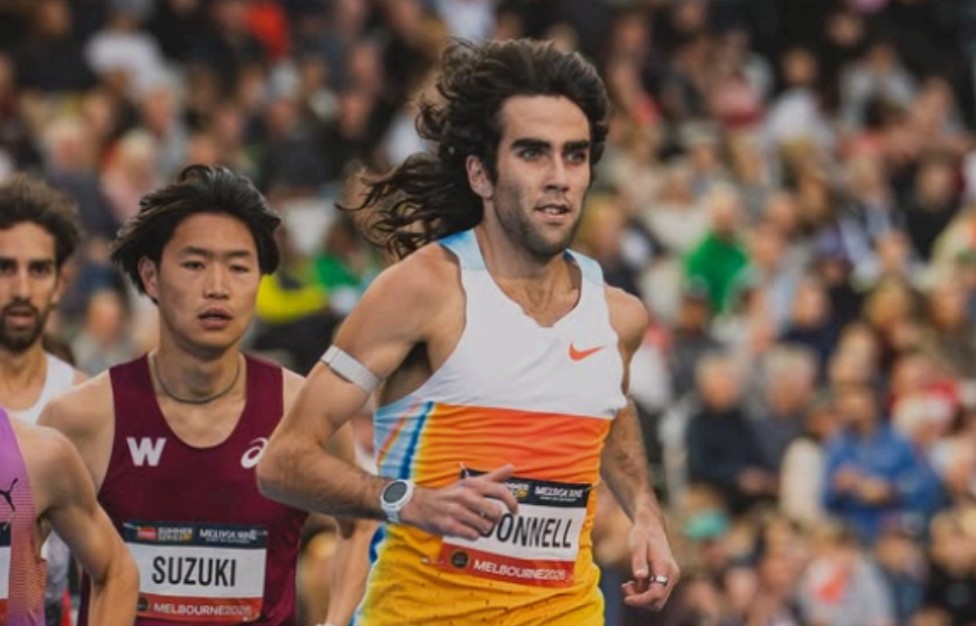


By RT Johno with thanks to Seth O’Donnell
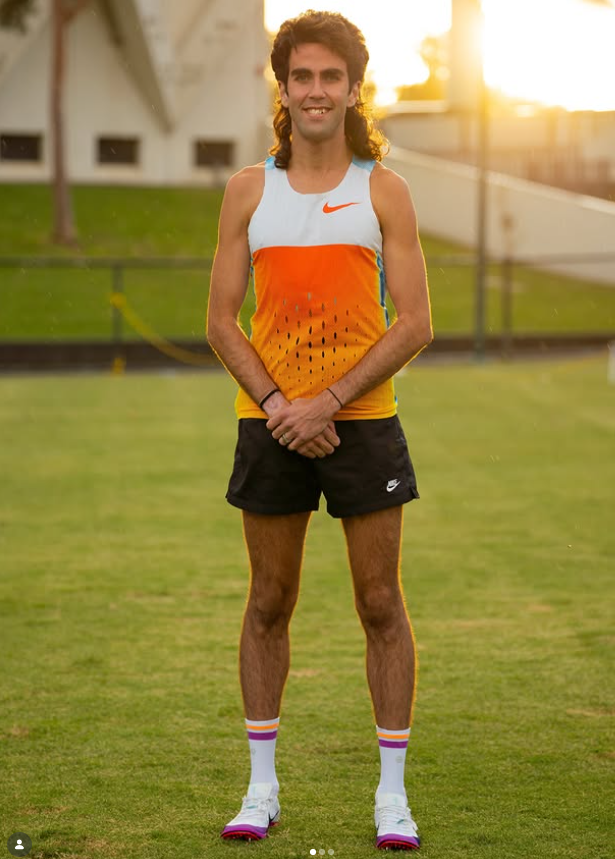 Seth O’Donnell was never supposed to be here. No little athletics. No junior cross country. No carefully constructed pathway through the state development squads and national camps that most elite Australian distance runners could trace back to childhood. He came through the AFL, played the game, and then somewhere around 2020, almost by accident, started running.
Four years later, he was a dual Australian champion. And at this year’s Australian Athletics Championships, he ran 13:12 for 5000m, finishing second only to Cameron Myers in one of the most competitive domestic 5000m races in recent memory.
The story of Seth O’Donnell is not a story about talent finding its natural home. It is a story about a man constructing something from first principles, without a template, without a decade of junior running to lean on, and doing it with a rigour and intelligence that most athletes never reach even with all those advantages.
From the Boundary to the Track
The conversion from AFL footballer to elite distance runner is not a common one. The physical demands overlap in some areas and diverge sharply in others. But what the AFL pathway does develop, often better than junior running can, is a tolerance for hard work in a structured team environment, a competitive instinct sharpened over years of contact sport, and a body that already knows how to suffer.
O’Donnell brought all of that when he showed up at a milers meet for his first competitive run over 1500m. What happened next was the kind of debut that makes coaches lean forward in their chairs.
“My first race was a 1500m at a milers meet. I led from the gun and ran 3:57. A couple of weeks later I won the State U20 5km in 14:44 with the same approach: honest running from the front.”
3:57 in your first competitive 1500m. 14:44 for the state U20 5km title a fortnight after that. Both races run the same way, from the front, making it honest, refusing to sit and wait. These are not just good performances for a debutant, they are performances that announce something real.
“What got me wasn’t the times,” O’Donnell says. “It was how quickly the effort was converting.”
That phrase is worth sitting with. For most runners, the effort-to-result ratio only improves slowly, over years of accumulated mileage, the patient accretion of aerobic base, the gradual refinement of economy. For O’Donnell, even in those first weeks, the conversion was happening at a rate that told him something significant was possible.
Running wasn’t on his radar before 2020. Then very quickly, he says, it became the thing he couldn’t stop thinking about. Anyone who has ever found their sport late, who has felt that specific electricity of realising you might actually be good at this, will recognise exactly what he means.
The Race That Reframed Everything
Debut performances are exciting. National titles are different. They are confirmation, proof that the early signal was real and not a statistical anomaly. For O’Donnell, that confirmation came in 2022 at the Australian Cross Country Championships.
“The real turning point was the Australian Cross Country title in 2022. A couple of years earlier I wasn’t a runner at all, and now I was the national champion. That reframed what I thought was realistic for me.”
Two years. From not being a runner at all to being the best cross country runner in the country. The cognitive recalibration required for that shift is enormous. The story you tell yourself about who you are and what you can do has to be completely rewritten. And when you rewrite it, the next chapter gets bigger.
2025 continued that upward arc. O’Donnell won both the 5000m and 10000m titles at the Australian Athletics Championships, a double that confirmed he was not a one-event specialist finding a soft spot in the field, but a genuinely complete distance runner capable of competing across the range. And then came the 13:12.
At this year’s Australian Championships, in a 5000m that included Cameron Myers, one of the most exciting young distance runners Australia has produced in a generation, O’Donnell ran 13 minutes and 12 seconds and finished second. It is a time that puts him firmly among the national elite. And the way he talks about that race tells you a lot about the kind of competitor he has become.
“Running 13:12 for 5000m and finishing second to Cameron Myers is a race I’ll look back on fondly.”
No bitterness about the result. No hedging. He ran a great race, someone ran a better one on the day, and he is proud of what he delivered. That equanimity is not accidental, and it connects directly to how O’Donnell thinks about competition itself.
View this post on Instagram
Demiurge: The Mental Architecture of a Race
Most elite athletes, when asked about mindset and pressure, reach for familiar language. Process focus. Staying in the moment. Controlling what you can control. The vocabulary is well-worn, useful but generic. Seth O’Donnell reaches for something considerably less expected.
“There’s a track called Demiurge on Meshuggah’s Koloss that lives in my head around this — the album spends a lot of time on the idea that forcing outcomes is a kind of failure and that the real work is assembling the pieces correctly.”
Meshuggah are a Swedish progressive metal band whose music operates at a level of technical and rhythmic complexity that rewards close attention in ways most music does not. Koloss, released in 2012, is one of their most acclaimed records, a sprawling, dense work built around themes of inevitability, control, and the tension between intention and outcome. Demiurge, the closing track, is both a physical and philosophical statement, nearly ten minutes of constructed precision.
For O’Donnell, this is not just a song he happens to like. It is a conceptual framework he carries into competition.
“I’m not very motivated by external things like times, rankings or proving anyone wrong,” he says. “What I’m focused on is executing my potential. The race isn’t a battle against pain or doubt; it’s the moment where all the training either expresses itself cleanly or it doesn’t.”
The Meshuggah connection makes this concrete. Demiurge, in its musical form, is the sum of thousands of individual decisions made correctly in the rehearsal room, in the writing process, in the physical practice of extraordinarily complex parts. The performance is not where the work happens. It is where the work reveals itself. If the pieces are assembled correctly, the outcome follows. Forcing it produces something worse than what the pieces, left to express themselves cleanly, would deliver.
Applied to distance running, this is a sophisticated and mature competitive philosophy. O’Donnell does not go to the start line trying to run a specific time. He goes to the start line having done the work, and the race becomes the moment of revelation.
“The pain inside a race isn’t something to override. It’s the signal that the pieces are doing what they should be doing. The self-talk I trust is narrow and concrete. It’s far more pragmatic, breaking the race into pieces I can actually control.”
Pain as signal rather than threat. This is a distinction that separates athletes who have genuinely made peace with the demands of their sport from those who are still negotiating with them. For O’Donnell, the discomfort of racing at threshold is information, confirmation that the physiological architecture he has spent months building is doing its job.
The Norwegian Model, Built From First Principles
If O’Donnell’s mental framework is unconventional, his training methodology is decidedly cutting-edge, drawn from the Norwegian double threshold model that has produced some of the most dominant distance runners in recent history.
“The backbone of my training is the Norwegian double threshold model. The principle I care about most is specificity of stimulus, every session has a physiological target I can measure. I lactate test regularly and use those values to set pace.”
The Norwegian model, popularised internationally by coaches like Marius Bakken and later refined through the work behind athletes such as Jakob Ingebrigtsen, centres on performing two threshold sessions per day at carefully prescribed intensities, with easy running sandwiched between and around them. The lactate testing component is critical: without blood lactate data, the athlete is estimating the physiological zone they are working in. With it, they can hit the target precisely, session after session.
For O’Donnell, who came to running without years of intuitive feel for his own body’s responses to training, this data-driven approach suits his disposition and his circumstances. He could not rely on accumulated experience to tell him whether a session was too hard or too easy. The numbers tell him directly.
The most significant adjustment in his most recent training block was not a change to the threshold sessions themselves, but to how he treated the easy running around them.
“The biggest shift in my last block was how I treat easy running. I’d been running easy about 70 seconds slower than threshold. Widening that gap completely changed my ability to handle threshold volume.”
This is a finding that the emerging research on polarised and threshold-based training increasingly supports. Easy running needs to be genuinely easy, not moderately comfortable, to allow the physiological systems to recover and adapt between quality sessions. Running what feels relaxed but is still metabolically demanding accumulates a residual fatigue that blunts the quality of the threshold work itself. O’Donnell figured this out through data and through a difficult stretch of overtraining.
Volume across his training year fluctuates considerably, from a high of 180 kilometres per week to a low of 110, depending on where he is in the cycle. “The sessions carry the fitness,” he says simply. “The easy running carries the system.” Recovery infrastructure is equally deliberate: sleep and nutrition take priority, with heart rate variability trends serving as an early warning system for accumulated fatigue or incoming illness.
View this post on Instagram
When the Plan Falls Apart
Elite training plans always look elegant in the spreadsheet. The stretch from December to February this year was a reminder that the body does not consult spreadsheets.
“One of the hardest stretches was December to February this year. Three illness or overload episodes in about 10 weeks, right in the middle of the most important block before championships.”
Three disruptions in ten weeks during the critical preparation phase. For many athletes, this would mean either pushing through and arriving at championships undertrained or overdone, or backing off and arriving there undertrained. O’Donnell did neither. He went back through the data.
“When I went back through the data the pattern was obvious,” he says. “The lesson: the thing that breaks you usually isn’t the session you remember, it’s the accumulation of choices that felt fine in the moment.”
This is one of the hardest lessons in endurance sport to internalise, and most athletes only learn it through exactly the kind of painful experience O’Donnell describes. Individual sessions rarely break athletes. It is the aggregated load of sessions that each felt sustainable that eventually tips the balance. The warning signs are in the data if you know how to read them. HRV trends, pace at a given lactate value, sleep quality, motivation levels. O’Donnell had the systems in place. He learned to read them more carefully.
The rebuild was methodical: strict easy paces, more LT1 work, reduced training density. The 13:12 at Nationals was the direct output of that rebuilt structure, a performance that emerged not despite the disrupted preparation block but in some ways because of what he learned from it.
Physio, Coach, Athlete: The Triple Life
What makes O’Donnell’s story genuinely unusual, beyond the AFL-to-elite-running arc, beyond the Meshuggah mental framework, beyond the Norwegian training model, is the life he is simultaneously running alongside all of this.
Twenty hours per week as a physiotherapist. Another ten to fifteen hours coaching runners. That is a substantial professional life by any measure, and he is doing it at the same time as training at national championship level.
But O’Donnell does not frame this as a compromise or a burden. He frames it as an advantage.
“The coaching and physio make me a better athlete because they force me to think harder about the principles I apply to my own training.”
There is genuine insight here. The experience of explaining training principles to athletes you are coaching forces a precision of thought that simply following your own program does not require. When you have to articulate why you are doing something, you understand it differently than when you are simply doing it. The physiotherapy work adds a layer of anatomical and biomechanical understanding that most athletes have to access through a third party. O’Donnell has it built in.
He came to running without a conventional background, and that meant building his understanding from first principles rather than inheriting a framework from coaches and clubs who had seen a thousand athletes come through before him. The triple life of physio, coach, and athlete is an extension of that same autodidactic instinct. He is still building the framework, still testing and refining the principles, and every athlete he works with teaches him something about his own preparation.
View this post on Instagram
What Comes Next
The Commonwealth Games are the near-term target. O’Donnell wants to contest both the 5000m and 10000m, and importantly, he is not satisfied with simply making the team. The distinction is one he draws explicitly.
“I want to be in shape to race them at that level, not just make the team.”
The thread that ties his entire story together, from that first 1500m led from gun to tape, through the cross country title, through the championship double, through the 13:12, is that O’Donnell has always wanted to race honestly and race his way. Making a team is a result. Racing at that level is a performance. He is interested in the performance.
The 13:12, he says, is a starting point. Not an arrival. The next version of himself will be the output of a better-informed training block, one built on the lessons of the disrupted summer, on the refined understanding of what easy running actually needs to look like, on the data accumulated through another season of lactate testing and HRV tracking and careful attention to the signals the body sends when you know how to listen.
“13:12 was a starting point. The next version of me is going to be the output of a better-informed training block.”
Seth O’Donnell was never supposed to be here. That is precisely why watching where he goes next is so compelling. He is building something original, without a template, without the comfort of a pathway that has been walked before. He is assembling the pieces correctly, and trusting that the outcome will express itself cleanly.
Meshuggah would approve.