

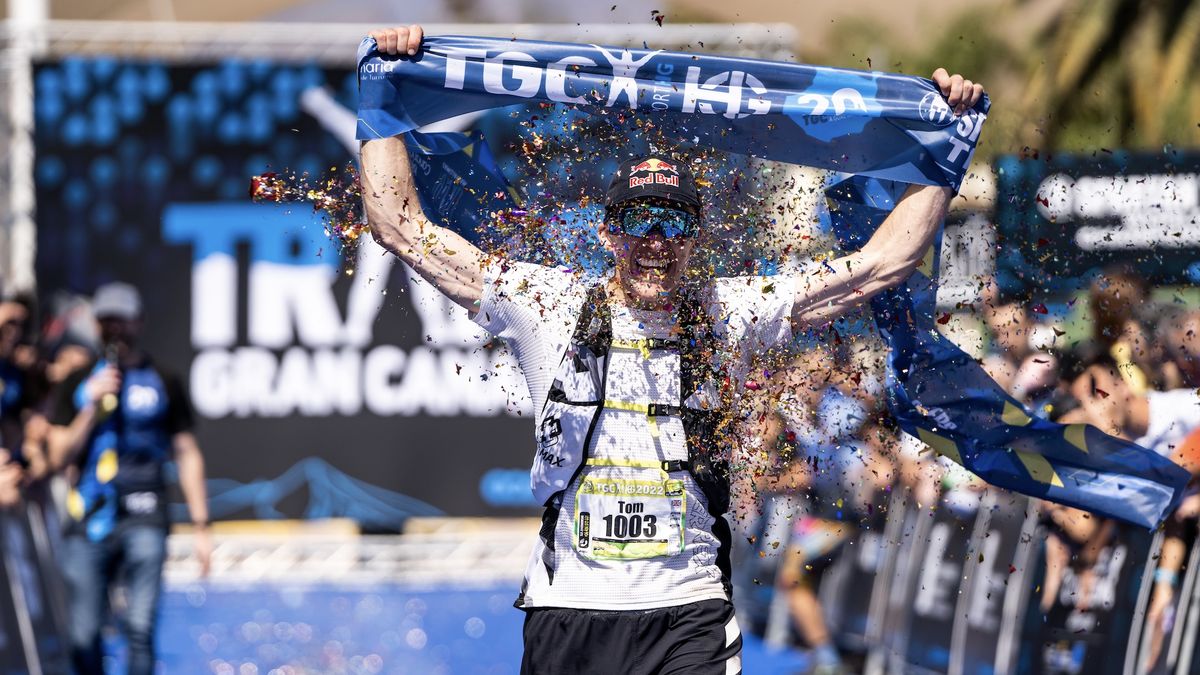


The former British Army captain who treats ultrarunning like a military operation has become the first British man to win UTMB. Here’s how precision, data, and a mindset shift delivered the ultimate victory.
The Surgeon, Not the Bulldozer
“I want to be a surgeon rather than a bulldozer.”
That single sentence captures everything about Tom Evans’s approach to ultramarathon preparation. While some athletes accumulate endless junk miles and hope for the best, Evans dissects each target race with military precision, identifying exactly what’s required and training specifically for those demands. Nothing more, nothing less.
In August 2025, this surgical approach culminated in a dominant UTMB victory, finishing over 30 minutes clear of second place in 19:18:58. Evans became the first British man to win the race since Jez Bragg in 2010, and did so after DNFs in 2023 and 2024 that had tested his resolve to breaking point.
The path from drunken bet to world champion is one of the most remarkable in ultrarunning. But what makes Evans’s story truly compelling isn’t the talent, which was always obvious. It’s the relentless refinement of process, the willingness to draw expertise from every corner of elite sport, and ultimately, the recognition that happiness matters as much as hard data.
From Drunken Bet to World Beater
Tom Evans was born February 3, 1992 in Sussex, England. He dabbled in track events and hockey as a youngster, but rugby was his primary focus. He represented England schoolboys and had trials with top flight club Harlequins before joining the British Army at 18.
During his eight years in the military, rising to the rank of Captain with the Welsh Guards, running took a back seat to operational duties. Then in 2016, he won the Beacons Ultra, his first ultramarathon. That night, fueled by a few beers and surrounded by friends who had completed the Marathon des Sables, Evans accepted a bet to outperform their results at the following year’s edition.
He stuck to his word. With only six months of preparation amid army commitments, training up to 90 miles per week, Evans finished third at the 2017 Marathon des Sables, the best result any European had ever achieved in the race’s history. The ultrarunning world took notice of this unknown British Army captain who had seemingly appeared from nowhere.
“I went out with a few small ambitions,” Evans later explained. “My main goal was to go out unknown and see what I could do. There was no pressure on my running so I could just focus on myself, focus on the race. Absolutely no one had any idea who I was on day one.”
The Speed Reserve Advantage
What separates Evans from most ultrarunners is his raw speed. His personal bests include a 13:40 5000m and a 63:14 half marathon, times that would be competitive at national level in road running. He represented Great Britain at the 2020 World Athletics Half Marathon Championships and helped Great Britain win European Cross Country Championships team gold in 2019.
Coach Scott Johnston of Evoke Endurance, who has guided Evans since the Western States 2023 build, emphasizes how crucial this speed is: “Both Ruth [Croft] and Tom have a high speed reserve, meaning they can run aerobically at a much faster pace than many ultra runners. These high end speeds allow them a wide range of successes at the ultra running race distances.”
Evans agrees that speed underpins everything: “I think being able to run fast is great because it puts your ceiling higher. If you can run a quick 50 miler, you can then run a quick 100 miler, but in order to run a quick 50 miler, you need to focus on improving your marathon. I think if you neglect your speed training then you will have a more difficult time getting faster and if you want to run faster you need to train faster.”
This philosophy explains why Evans mixes shorter events into his annual calendar. Road races and cross country races aren’t distractions from ultra preparation. They’re essential components of maintaining the top end fitness that gives him advantages over competitors who focus exclusively on volume.
The Evoke Endurance System
Since connecting with Scott Johnston, Evans has followed a distinctive training philosophy centered on one key insight: in ultra distances, the heart doesn’t get tired. What limits performance is muscular endurance, the muscles’ ability to sustain repeated contractions over time.
“For most people in these long races, what I’ve worked on is making it so they don’t see that decline,” Johnston explains. By focusing on overloading the legs in training, rather than purely chasing aerobic gains, athletes can maintain a higher percentage of their VO2max late in races when everyone else is fading.
The evidence at UTMB 2025 was striking. Ruth Croft, also coached by Johnston, hit her highest heart rate of the entire event just five kilometers from the finish line. Her legs weren’t limiting her output even after 170km and 10,000m of climbing.
Johnston’s weekly training template for Evans typically includes:
Key sessions: Weighted uphill intervals: Ascending at 20% gradient with approximately 12kg of water on his back, totaling 1000m of vertical gain. After dumping the water at the top, practicing speedy descents.
Johnston’s prescription: “The load you carry must be heavy enough that the local fatigue in your legs is the limitation, not your breathing. Disregard heart rate in these ME workouts. If your legs are not feeling a low level burn for the full climb, you’re not getting maximum benefit.”
Weekly structure: The training looks remarkably similar between Johnston’s athletes despite different event targets. Each week generally includes threshold sessions, long easy runs, weighted vertical work, downhill specific training, and recovery. The art is in periodization and individualization.
A Typical Training Week: Chamonix, August 2025
In the final preparation block before his UTMB victory, Evans released details of a typical week. The balance of quality, volume, and recovery reflects years of refinement.
Monday: AM: 2 hour run with 4 x 8 minutes at marathon pace on flat (around 5 minute miles) PM: Gym. “In the UK it’s typically heavier work, legs and upper body. In Chamonix it was far more bodyweight, lots of core, and more prehab/rehab, lots of knee health and downhill quad conditioning.”
Tuesday: AM: Uphill weighted training hike/run for 3.5km (1000m elevation) with 15kg pack. “I ditch the pack at top, run down fast and whatever my heart rate was on the first climb, I aim to average the same going back up without the pack (around 10 to 15 minutes quicker).” Cable car back down. PM: Passive heat in sauna
Wednesday: AM: 50 minute shakeout run PM: Overnight 5.5 hour run on UTMB course for specificity (10:30pm start)
Thursday: Rest day
Friday: 3 hour easy run (just inside 7 minute miles on flat sections), hiking on some uphills PM: Gym
Saturday: AM: Hill strides: 5 x (15 seconds, 30 seconds, 45 seconds, 60 seconds with jog down recovery) PM: 90 minutes easy plus passive heat
Sunday: 3 hour run on the course with 3 x 15 minutes at 100 mile race effort pace
Favorite session: “A vertical kilometer on the treadmill. I have a custom treadmill that goes to 25% incline, so over 4km you’ll climb 1000m in around 30 minutes.”
Least favorite session: “A downhill specific session such as 4 x 10 minutes as hard as you can. Aerobically it’s not hard but you have to concentrate so much. It’s high risk but very high reward. Or anything in the cold I don’t really like!”
The Evolution: From Overtraining to Optimization
Evans has been transparent about the mistakes that shaped his current approach. Early in his career, he fell into the trap of assuming more was always better.
“Traditionally athletes would ask themselves, ‘what’s the maximum amount of training I could do in a week?’ For example, I’m doing 25 hours a week. What happens if I do 27 hours? What happens if I do 29 hours? I even had a couple of weeks over 30 hours.”
The result was predictable: “I was just broken and not enjoying it.”
Working with Johnston, Evans flipped the script. Instead of asking how much training he could survive, they asked what was the minimum needed to achieve the demands of the race.
“I reckon my coach said ‘what are the demands of the event’ about 1,000 times in the last six months,” Evans joked after his Western States 2023 victory. “And why would you train for anything else? It makes you so prepared that there shouldn’t be any question marks or unknowns. You just go and execute.”
For Western States 2023, this meant 125 miles per week since January, blending training on roads, trails, and track while based in Flagstaff, Arizona at 7,000 feet. He did long trail runs with teammate Cordis Hall, joined NAZ Elite marathoners for fast road sessions, and ran tempo track workouts with Molly Seidel and other speedy road and track runners.
The Multi Disciplinary Approach
Evans draws knowledge from every corner of elite endurance sport. Partnered with sponsors like Red Bull and Maurten (and previously Adidas Terrex, now ASICS), he has access to cutting edge testing far beyond typical ultrarunning parameters.
“My coach works in mountain running, but by seeking experience from triathlons, cycling, strength and conditioning, psychology, and nutrition, I can gain so much more,” he explains. “There’s the saying ‘if you’re the smartest person in the room, you’re probably in the wrong room.’ I fully believe in that.”
Heat, altitude, force, and motion testing all inform his preparation. Lab work extends beyond standard lactate and VO2max protocols to include biomechanical analysis, gut training protocols, and psychological profiling.
The military background provides the framework: “The Army teaches you the need to be adaptive and flexible. You’d be given a mission, and you’re the one who is responsible for figuring out how to get to that endpoint. And that’s why I look to these coaches and experts from all different disciplines to help. Of course, on race day, it’s just me, but I’m taking all this learning and preparation with me for whatever happens on the day.”
Fueling the Machine
Evans has been at the forefront of the carbohydrate revolution in ultrarunning. Where previous generations focused on fat adaptation and relatively modest caloric intake, Evans has pushed toward aggressive fueling strategies.
“I think the benefit of being fat adapted is less a thing now, to a certain extent,” he said in 2023. “It’s got to the point where ultrarunning is so competitive, and with a lot of races at altitude, we’re using carbohydrates the whole time.”
His approach is periodized and purposeful. Training runs might be fasted to build metabolic flexibility, or they might replicate race day demands.
“I might do a four hour training run without breakfast and only have amino acids for two and a half hours, then start fueling low carb. Or I might do runs that replicate UTMB. I’ll have sodium bicarb before, then go and fuel on 120 grams straight from the off. You get used to doing that very quickly, and you recover a lot better.”
At UTMB 2025, Evans consumed approximately 85 to 88 grams of carbohydrates per hour, notably less than the 120 grams per hour he had previously attempted. The more moderate intake came after learning from earlier races where aggressive fueling contributed to gastrointestinal distress and DNFs. Finding the balance between maximum fuel and gut tolerance is highly individual, and Evans learned his limits the hard way.
Heat: The Secret Weapon
For 2025, Evans made two major changes to his preparation. One was the fueling refinements already discussed. The other was switching from active to passive heat acclimation.
“I found that training at such high volume, active heat acclimation just destroyed me,” he explains. “I was so tired and not recovering, so we swapped that to passive heat acclimation. I didn’t do any active heat sessions in this build, and although the race didn’t end up being hot, I felt way more prepared and far less tired.”
Active heat acclimation involves training in hot conditions, such as running in heat suits or exercising in heated rooms. Passive heat acclimation uses hot baths or saunas without additional exercise stress.
The distinction matters for athletes already training at maximum sustainable volume. Adding heat stress to training sessions can tip the balance from productive overload to breakdown. By separating heat exposure from training load, Evans could capture the adaptation benefits without compromising recovery.
“Heat sessions have been huge for us, both before and after Western States,” he noted in 2023. “What you can gain from prepping for heat in a week has a similar effect to what you can get training at altitude for a month. If the race is hot, brilliant, you’re prepared for it. If the race isn’t hot, even better, because you’ve still got this performance booster.”
The 2021 Setback and Olympic Dream
Evans’s trajectory hasn’t been linear. In 2021, a stress fracture required knee surgery, ending his dream of representing Britain in the marathon at the Tokyo Olympics. He had been chasing dual excellence, combining ultrarunning prowess with legitimate road credentials.
The recovery period at Red Bull’s Athlete Performance Center in Austria forced patience. But Evans emerged with refined perspective and eventually returned stronger, winning the 2022 Madeira Island Ultra Trail and taking third at UTMB 2022 behind Kilian Jornet.
“I think there are so many lessons and elements that you can take from being able to run a fast 5k onto the trails,” he reflects. “I like mixing in different events throughout the year, like road races and cross country races to keep my training interesting and my motivation up.”
The Mindset Shift: From Needing to Wanting
Perhaps the most significant evolution in Evans’s career came not in training methodology but in psychology. After third place at UTMB 2022, he entered 2023 and 2024 feeling pressure to win. He DNF’d both years.
“I was snatching at things,” he admits. “I felt like I needed to win more than I wanted to win.”
Coach Johnston delivered a simple message: if you want to win, first you have to finish.
For 2025, everything changed. Evans became a father when daughter Phoebe was born in May. His wife, British triathlete Sophie Coldwell, was rebuilding her own training after childbirth. The family moved together to Chamonix for the preparation block, making it “home from home” rather than an isolated training camp.
“Ten minutes before we drove to the start line at UTMB I was actually changing Phoebe’s nappy,” Evans recounts. “Yes, I’m professional, but Phoebe comes first and she needs us more than I needed to win UTMB.”
The concept behind the 2025 build was simply to have fun. “I train so much better when I’m happy, and if you train better you’ll probably race better. It was the first time that we’d made a really conscious effort to bring people along with us and make it home from home.”
Cognitive performance consultant Dr. David Spindler supported the approach. Rather than isolation and deprivation, Evans found that joy enhanced performance.
“I used to think that in order to be my best I had to train at my absolute limit where I couldn’t run one more mile in the week or climb another metre. I needed to be completely wrecked by the end, and I needed to be locked away in a small apartment at altitude with no distractions. And I’m really good at that, but it’s not fun.”
The race result spoke for itself: a 30 minute winning margin, looking fresh enough that he performed his signature “shoey” (drinking from his shoe) at the finish line.
“Genuinely, my goals today weren’t to win, my goals today were to look at myself in the mirror and be proud of what I achieved,” Evans said afterward. “If you try too hard to win, which I had done previously, it’s really difficult. But this year it was all about letting the race come to you.”
2017 to 2025: The Career Arc
The numbers tell a story of rapid ascent, setback, and ultimate triumph:
2017: 3rd Marathon des Sables (first major ultra, best European finish ever) 2017: 4th CCC at UTMB 2018: 1st CCC at UTMB, course records at Coastal Challenge Costa Rica and South Downs Way 50, 3rd Trail Running World Championships 2019: 3rd Lake Sonoma 50, 3rd Western States 100 (fastest overseas time), left British Army to run full time, European XC Championships team gold 2020: 1st Tarawera Ultramarathon, World Half Marathon Championships (64th, 63:14 PB) 2021: Knee surgery, missed UTMB 2022: 1st Madeira Island Ultra Trail, 3rd UTMB 2023: 1st Western States 100, DNF UTMB 2024: DNF UTMB, 2nd Lavaredo, 3rd Transvulcania 2025: 1st Arc of Attrition, 1st Tenerife Bluetrail, 1st UTMB (first British male winner)
What We Can Learn
Evans’s approach offers several insights for runners at all levels:
Specificity trumps volume. Understanding the exact demands of your target event, then training specifically for those demands, is more valuable than simply accumulating miles. “Why would you train for anything else?” as Evans puts it.
Speed matters at all distances. Maintaining fast running ability through shorter races and track work gives you a higher ceiling for longer events. The ability to run aerobically at faster paces provides advantages that pure ultra specialists can’t match.
Draw expertise from everywhere. No single sport has all the answers. Cycling, triathlon, swimming, strength and conditioning, psychology, and nutrition all offer insights that can enhance running performance.
Train the gut. Fueling tolerance is trainable. Practice race nutrition in training, but also recognize that maximum theoretical intake may not be your personal optimum. Finding the right balance is individual.
Happiness enhances performance. The shift from needing to win to wanting to win, from isolation to family, from deprivation to joy, was transformative for Evans. Sometimes the most important training adaptation isn’t physical at all.
If you want to win, first you have to finish. Patience and consistency beat desperate attempts at heroics. Let the race come to you.
The Military Mind
Eight years in the British Army shaped Evans in ways that continue to influence his racing. The discipline, the problem solving orientation, the ability to execute under pressure all translate directly.
“My time in the military has definitely shaped my mental approach to my day to day life,” he reflects. “I think mostly with integrity, knowing that I am making the right decision for my goals. That may be in making sacrifices to not see friends and be away on training camp. Or going and doing that run in the cold, wet and dark UK weather.”
But it’s not about specific experiences or war stories: “No real specific experiences that I pull from but for me it’s the ability to keep going under the circumstances and try to achieve what I have set out to do.”
Taking the Union flag in the home straight at UTMB, tying it to his back like a cape, pausing a meter before the finish line to salute, Evans honored his military background while completing ultrarunning’s ultimate achievement for a British athlete.
Then he cracked open a Red Bull, poured it into his shoe, and took a celebratory drink. Because precision and joy aren’t mutually exclusive.
Key Training Takeaways
Weekly volume: Typically 125+ miles during peak builds, but emphasis on quality over quantity
Speed work: Regular track and road sessions, including 4 x 8 minutes at marathon pace (approximately 5 minute miles)
Vertical training: Weighted uphill intervals (12 to 15kg pack) with 1000m gain per session
Downhill specific: Hard tempo descents to build eccentric strength and confidence
Long runs: Course specific where possible, including overnight runs for UTMB preparation
Cross training: Cycling, gym work for strength and prehab
Heat acclimation: Passive (sauna/hot bath) rather than active during high volume phases
Race nutrition: 85 to 90 grams carbohydrate per hour, periodized gut training in buildup
Coach: Scott Johnston, Evoke Endurance
Key PBs: 5000m: 13:40, Half marathon: 63:14
Primary Sources (Direct Interviews and Statements)
- Athletics Weekly. (2025). “How they train: Tom Evans.” https://athleticsweekly.com/performance/how-they-train-tom-evans-1040008059/
- Vert.run. (2024). “Tom Evans Q&A: Insights from a Trail Running Champion.” https://vert.run/tom-evans-qa/
- Trail Runner Magazine. (2025). “Tom Evans Approaches Ultra Training With Surgical Precision.” https://www.trailrunnermag.com/people/tom-evans-approaches-ultra-training-with-surgical-precision/
- Trail Runner Magazine. (2023). “How Tom Evans Won the Western States 100.” https://www.trailrunnermag.com/people/60635/
- Maurten. (2023). “Eyes on the prize — a Tom Evans story.” https://www.maurten.com/magazine/western-states-tom-evans
- Ian Corless. (2017). “TOM EVANS – Marathon des Sables #MDS 2017 Part One.” https://iancorless.org/2017/07/03/tom-evans-marathon-des-sables-mds-2017-part-one/
- Runner’s Tribe. (2024). “RT Snap Q & A Series: Tom Evans | From Army Grit to Ultramarathon Glory – Lessons, Wins, and Resilience.” https://runnerstribe.com/features/tom-evans-from-army-grit-to-ultramarathon-glory-lessons-wins-and-resilience/
- The Physiology of Endurance Running Podcast. (2025). “The Athlete Series: Tom Evans.” https://creators.spotify.com/pod/profile/running-physiol-podcast/episodes/The-Athlete-Series-Tom-Evans-e3781h3
Coaching and Training Methodology
- iRunFar. (2025). “Coaching the 2025 UTMB Champions: Scott Johnston’s Focus on Muscular Endurance.” https://www.irunfar.com/coaching-the-2025-utmb-champions-scott-johnstons-focus-on-muscular-endurance
- TrainingPeaks. (2025). “Training for the UTMB Win: Ruth Croft and Tom Evans Gain Speed.” https://www.trainingpeaks.com/blog/ruth-croft-tom-evans-utmb-2025/
- TrainingPeaks Coach Blog. (2025). “Scott Johnston’s Winning Formula for Ruth Croft and Tom Evans at UTMB.” https://www.trainingpeaks.com/coach-blog/scott-johnston-winning-formula-ruth-croft-tom-evans-utmb/
- Evoke Endurance. (2025). “Training Peaks Podcast: Scott Johnston’s Winning Formula for Ruth Croft and Tom Evans at UTMB.” https://evokeendurance.com/resources/training-peaks-podcast-scott-johnstons-winning-formula-for-ruth-croft-and-tom-evans-at-utmb/
Race Coverage and Results
- Athletics Weekly. (2025). “Tom Evans takes Ultra-Trail du Mont-Blanc victory.” https://athleticsweekly.com/news/tom-evans-takes-ultra-trail-du-mont-blanc-victory-1040007264/
- Outside Online. (2025). “2025 UTMB Mont-Blanc Live Race Updates and Results.” https://run.outsideonline.com/trail/trail-racing/utmb-race-live-updates-results/
- Outside Online. (2025). “Tom Evans Approaches Ultrarunning With Surgical Precision.” https://run.outsideonline.com/people/tom-evans-approaches-ultra-training-with-surgical-precision/
- UTMB World. Race Results Database. “Tom Evans.” https://utmb.world/runner/1410311.tom.evans
Biographical and Background
- RUN247. (2023). “Tom Evans Biography & News.” https://run247.com/runners/tom-evans
- Wikipedia. “Tom Evans (runner).” https://en.wikipedia.org/wiki/Tom_Evans_(runner)
- Grokipedia. “Tom Evans (runner).” https://grokipedia.com/page/Tom_Evans_(runner)
- National Running Show. “Tom Evans.” https://nationalrunningshow.com/profile/tom-evans
- SunGod. “Tom Evans.” https://www.sungod.co/en-gb/explore/pro-team/tom-evans
- Jamie Gregory Coaching. “About Tom Evans | Elite British Ultra Runner & Endurance Athlete.” https://jamiegregory.com/about/
- TrainingPeaks Coach Profile. “Tom Evans | Running Coach.” https://www.trainingpeaks.com/coach/teamevansultra
- Red Bull. “Tom Evans: Ultrarunner.” https://www.redbull.com/us-en/athlete/tom-evans
Nutrition and Fueling
- Born on the Trail. (2025). “Do You Really Need 120g of Carbohydrates per Hour?” https://bornonthetrail.substack.com/p/do-you-really-need-120g-of-carbohydrates
- Maurten. “How to fuel.” https://www.maurten.com/how-to-fuel
- ITRA. (2025). “Ask Maurten Anything — fueling advice.” https://itra.run/en/106/news/ask-maurten-anything-%E2%80%94-fueling-advice
Training Plans and Programs
- Vert.run. (2025). “UTMB Mont-Blanc 100M Training Plans by Tom Evans.” https://vert.run/hoka-utmb-mont-blanc-utmb-100m/
World Athletics and Official Records
- World Athletics. “Tom EVANS Profile.” https://worldathletics.org/athletes/great-britain-&-n.i./tom-evans-14813646
- runbritain rankings. “Tom Evans.” https://www.runbritainrankings.com/runners/profile.aspx?athleteid=789203
Key Data Points and Source Attribution
| Data Point | Source |
|---|---|
| Born February 3, 1992 in Sussex | RUN247, Wikipedia |
| 8 years British Army, rank of Captain | Multiple sources |
| Welsh Guards regiment | Grokipedia |
| 2016 Beacons Ultra win (first ultra) | RUN247, SunGod |
| Drunken bet leading to MDS entry | Multiple sources |
| 2017 MDS 3rd place, best European ever | Multiple sources |
| 2018 CCC win at UTMB | Multiple sources |
| 5000m PB: 13:40 to 13:41 | Vert.run, TrainingPeaks |
| Half marathon PB: 63:14 | Physiology podcast, World Athletics |
| 2019 left British Army | Grokipedia |
| 2019 European XC Championships team gold | RUN247 |
| 2020 World Half Marathon Championships 64th | Wikipedia, Grokipedia |
| 2021 knee surgery | Wikipedia, Vert.run |
| 2022 UTMB 3rd place (20:34:36) | Grokipedia, multiple sources |
| 2023 Western States 100 win (14:40:22) | UTMB World, Trail Runner |
| 2023 UTMB DNF | Multiple sources |
| 2024 UTMB DNF | Multiple sources |
| 2024 Lavaredo 2nd (12:00:45) | UTMB World |
| 2025 Arc of Attrition win (6:54:40) | UTMB World, Athletics Weekly |
| 2025 Tenerife Bluetrail win | Athletics Weekly |
| 2025 UTMB win (19:18:58), 30+ min margin | Athletics Weekly, Outside Online |
| First British man to win UTMB | Athletics Weekly |
| Wife: Sophie Coldwell (triathlete) | Wikipedia, Athletics Weekly |
| Daughter: Phoebe (born May 2025) | Athletics Weekly |
| Coach: Scott Johnston, Evoke Endurance | Multiple sources |
| 125 miles per week (Western States build) | Trail Runner Magazine |
| Training in Flagstaff at 7,000 feet | Trail Runner Magazine |
| 85 to 88g carbs per hour at UTMB 2025 | Born on the Trail |
| Previous attempts at 120g/hour caused GI issues | Born on the Trail |
| Passive vs active heat acclimation switch | Athletics Weekly |
| Weighted uphill training (12 to 15kg pack) | TrainingPeaks, Athletics Weekly |
| Custom treadmill at 25% incline | Athletics Weekly |
| Robbed at knifepoint in Cape Town 2023 | Outside Online |
| Jez Bragg last British male UTMB winner (2010) | Athletics Weekly |
| Lizzy Hawker five time female UTMB winner | Athletics Weekly |
Podcast and Video Sources
- YouTube. Tom Evans “No Stone Left Unturned” mini series (referenced in Athletics Weekly)
- TrainingPeaks CoachCast with Scott Johnston and Dirk Friel