



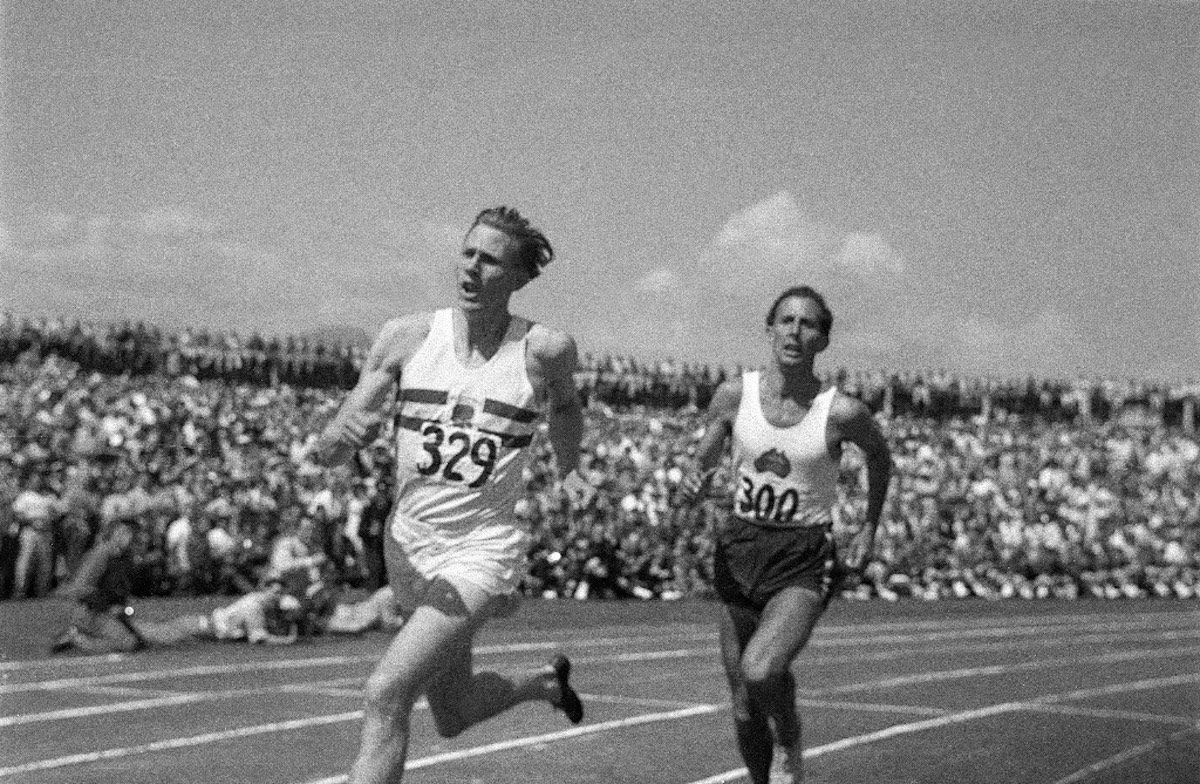
Back in the days when John Landy was approaching the four-minute mile, a break-through 4:02.1 in Melbourne interclub at the end of 1952 attracted scepticism and praise in almost equal measure.
Praise, because his performance re-ignited the chase for the first sub-4 miles; scepticism because Landy at the time was a failed Olympic athlete (run out in the heats of both 1500 and 5000 in Helsinki only months earlier) and also because – well, because Melbourne. World-class athletics happened somewhere else, not in Australia.
A prime example of the negative reaction came from the delightfully named – for fans of the British comedy series Minder (look it up) – Arthur Daley. Writing in no less a publication than the New York Times and mentioning the calibre of the athlete, the competence of the officials and timekeepers and even questioning the accuracy of the track, Daley sniffily opined: “Pass the salt.”
Seventy-four years later we are much more sophisticated. Or are we?
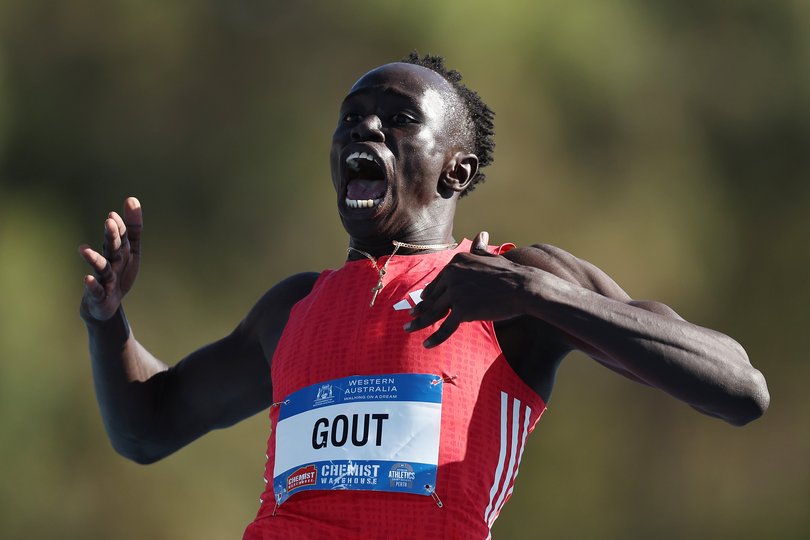
Gout Gout runs 19.67 seconds for 200 metres to win his second Australian championships at the distance was still over eight months short of his nineteenth birthday. That represented an improvement of 0.35 seconds over his previous wind-legal PB of 20.02.
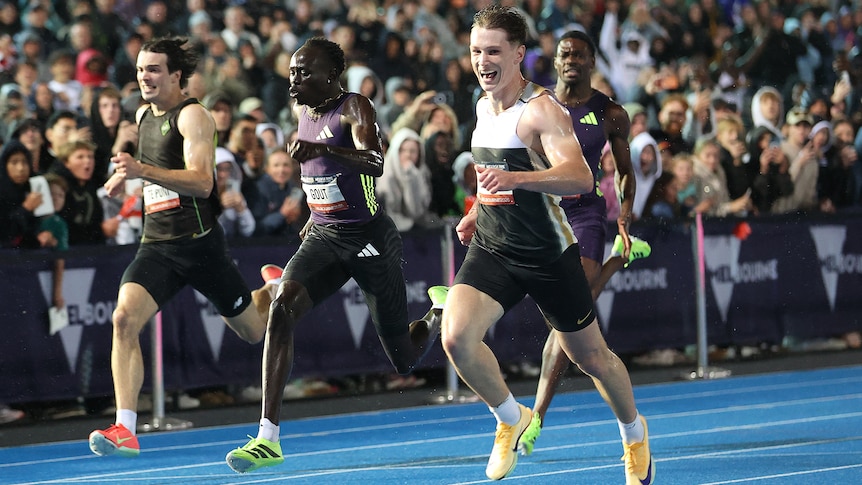
Unlike 1952 Landy, however, Gout has already established his credentials as an emerging talent. Silver medallist aged 16 at the last world U20 championships, training with Noah Lyles courtesy in large measure of a training grant from sponsor adidas and making the wise choice to run his 20.02 in Ostrava last year rather than Melbourne interclub.
None of your “pass the salt” scepticism then. Rather, the reaction this time was “unicorn conditions.” As defined on LetsRun, where this columnist read it, unicorn conditions are unusually, even freakishly, favourable to the athlete.
As when, for example, the wind blows from the west for the Boston marathon which is point-to-point from Hopkinton to Boston’s CBD. It is also downhill overall. Despite some significant climbs – Heartbreak Hill, you may have heard of it – the first 10 miles and the last six see significant downhill running.
And 2026 offered ‘unicorn conditions’. Neither the running press nor mainstream media shied away from mentioning this, it must be acknowledged, but you’d struggle to find any emphasis on it despite the fact that the race produced a slew of superfast times of the like not seen since …. checks notes …. the last time such conditions prevailed.
Unicorns, anyone? Nary a mention despite some amazingly fast splits on the downhill sections of the course.
I’m not critical of LetsRun coverage of Gout. Ignoring the unicorn bit, its analysis of the men’s 200 was pretty much spot on. The most common ‘knock’ on the race was around the first seven running personal bests, from second-placed Aidan Murphy’s 19.88 (0.53 pb) and Gout’s 0.35. Third, fourth and fifth improved by 0.20-0.30, sixth and seventh by 0.14 and 0.06, respectively.
Why? The official wind reading was 1.7 metres per second, a tailwind just inside the legal limit of 2mps. But the wind across the bend was crucial. I belong to a chat group mainly populated by former sprinters and sprint coaches who have forgotten more about 100 and 200 than I will ever know.
One participant speculated that the wind across the bend was most favourable. Harking back to Peter Norman, the 1968 Mexico Olympic silver medallist whose 200 record Gout broke last year, he commented:
“I was reminded of the famous across-the-bend wind at the 1968 Nationals at ES Marks Field, which were also the Olympic Trials.
“It was a Sydney north easter, just like we saw out at Homebush (venue for Gout’s run, LJ), coming diagonally across the turn. It was also under 2m/sec.
“My unreliable memory was that the 200 result was: 1 Peter Norman 20.5, 2 Greg Lewis 20.6, 3 Phil King 20.7 (it was, and the other three finalists ran 20.7, 20.8 and 20.9: LJ)
“I think all were PBs at the time (so do I, LJ).”
The Sydney nor’-easter also helps regardless of the reading in the straight. My own favourite example came at the 1996 national champs were it registered as a headwind of 2.6 as Melinda Gainsford Taylor won the women’s title in a fast 22.33 but a tail of 2.9 as Steve Brimacombe ran 20.42 to take the men’s title just minutes later.
On that occasion, the official wind reading half-way along the main straight was irrelevant because in both races it was the tailwind across the bend that rendered the most assistance.
Now, to Boston where the unicorn conditions are the tailwinds which blow strong about once every 10 years. This is ironic, as the course is not otherwise fast – a fact borne out by results most years. Boston is slower than more famous unaided courses like Berlin, Chicago and Tokyo.
As mentioned, men’s winner John Korir won in a race record 2:01:52, closing with a second half 60:02, including a 28:10 from 30 to 40km and a 6:02 final 2.195km.
The previous record was 2:03:02 by Geoffrey Mutai in 2011, another year in which the wind blew strong behind the runners. A better indicator may be the year-on-year comparison from 2025 (also wind-aided, but not as strong as this year). Seven of last year’s top 10 ran again in 2026, improving an average of two minutes seven seconds, though only one placed higher than he had the previous year.
As well as the wind, there was a cooperative attitude to taking the race out hard and hanging on. Seventh place Charles Hicks (in 2:04:35!) told LetsRun: “They mentioned it a couple times in the meetings before the race that, you know, you’ve got a tailwind, you should go for it.
“And I think that got in a lot of people’s heads. So I think it really pushed what people felt they were capable of and also made people front-run in times where they maybe wouldn’t have in another race, because the cost was very negligible.”
Although Boston’s downhills make it record-ineligible (though not usually fast!), this year 16 of the first 20 men ran ‘personal bests’. The affect on women’s race was not as pronounced, though winner Sharon Lokedi ran a 67:48 second half including 14:48 from 35 to 40km.
If that’s not indicative of unicorn conditions it’s hard to know what is.
Unicorns, it seems, are like peak-hour trams. You wait forever to see one, then two – or in the case of Boston 2026, a whole herd – come along at once.