



By Caleb Rook
I’m based in sunny Queensland now, but we grew up in Tassie in the late 80’s and early 90s, hiking and camping in The Walls of Jerusalem and Cradle Mountain National Parks.
Back then, the legendary fight for the Franklin River was still fresh on the political landscape. I knew the stories of multinational mining companies and state forestry decimating the landscape at almost unimaginable scale.
I’d seen logging trucks hauling impossibly large trees down the highways past Launceston and Hobart on their way to be turned into pulp, sent across the ocean and returned as paper. I’d also experienced the protests by the community trying to stop the destruction.
Knowing the stories of takanya’s ancient rainforests of giant trees, I was keen to experience them for myself. I also wanted to do something to help protect the places that had sparked my love of nature – having a crack at this epic ultra was the perfect opportunity.

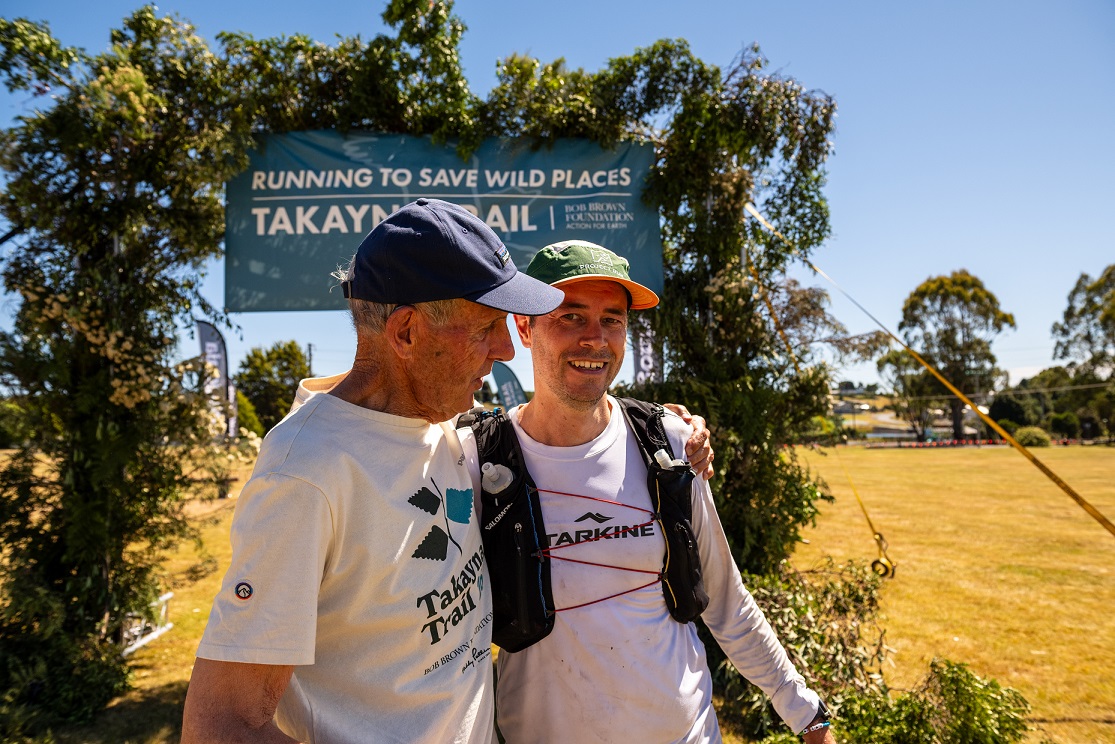
The takanya ultra had been on my radar since I supported my twin brother, Zach, in his run (and commendable 4th place) in 2022. Unfortunately, I was injured at the time and confined to race headquarters in Waratah, watching runners come in with giant smiles on their faces for a hug with my mum’s hero, Bob Brown.
I spent a solid two years planning my return, building up to a point where I felt ready to take on the challenging 62 km distance and over 2500m of elevation.
It did not disappoint.
Anyone in the trail running community knows how great the people are – takanya brought together some of the best. Pre-race vibes were high, the bus ride to the start line was a reminder of how diverse the coalition to save this wild place is – runners from different states and territories, tradies, teachers, unionists, professionals, and even an elected member of parliament.
Before we kicked off, race director Majell requested a moment of silence to listen to the sounds of the forest and see how many birds we could hear – not your average starting chorus.

The first 7 km were a fast downhill on gravel roads, at the bottom of the hill (and one of only two aid stations) – we took a hard right into the forest and the real race began…
The next 7 hours included some of the most incredible forest and steepest hills I’ve had the privilege to tackle. At various points, a flock of black cockatoos interjected, jostling high above in the branches of the mighty mountain ash trees. Multiple river crossings, including the knee-deep Huskins at 21 km, served as water refill points. At times, I ran for long stretches alone in the shade of the canopy, at other points I shared the trail with runners from the 62, 37 and 22 kilometre races. Complex single trail, well-worn 4×4 tracks, muddy rainforest sections, button grass plains and hiking tracks lead us from south to north through takanya.
I had started with the male and female 62 km leaders, ran with the 37 km winner and had the 62 km runner behind me catch up to check my nav and share a few moments before the second aid station.
Even in the rainforest, I’m a competitive person. I wanted to finish strong. The last 12 km was a steady climb out from the Magnet mine through the northern edge of takanya, along an inescapable ankle deep watercourse and out to the finish line at Waratah. I locked in hard and pushed through the last few kilometres on very tired legs. The final 150m is a downhill beside the sealed road into Waratah, ending after 7 hours and 50 minutes with my own well-earned hug from Bob in third overall – one place better than my brother had done in ’22. Easily the hardest thing I’ve done on two legs.

That evening we learnt that, as a result of tireless campaigning, the single biggest threat to takanya – a mining waste dam proposed by Chinese mining company MMG – had quietly applied for their toxic tailings dam application to be constructed at a new location, the lesser of two evils, outside of the Tarkine’s pristine rainforest. A historic win and a full circle moment back to where this started for me, with the folklore of the Franklin Dam campaign victory.
This year, the event has raised almost $380,000. This support will go to the Bob Brown Foundation to ensure one of our last wild places stays that way – no matter the challenge.