

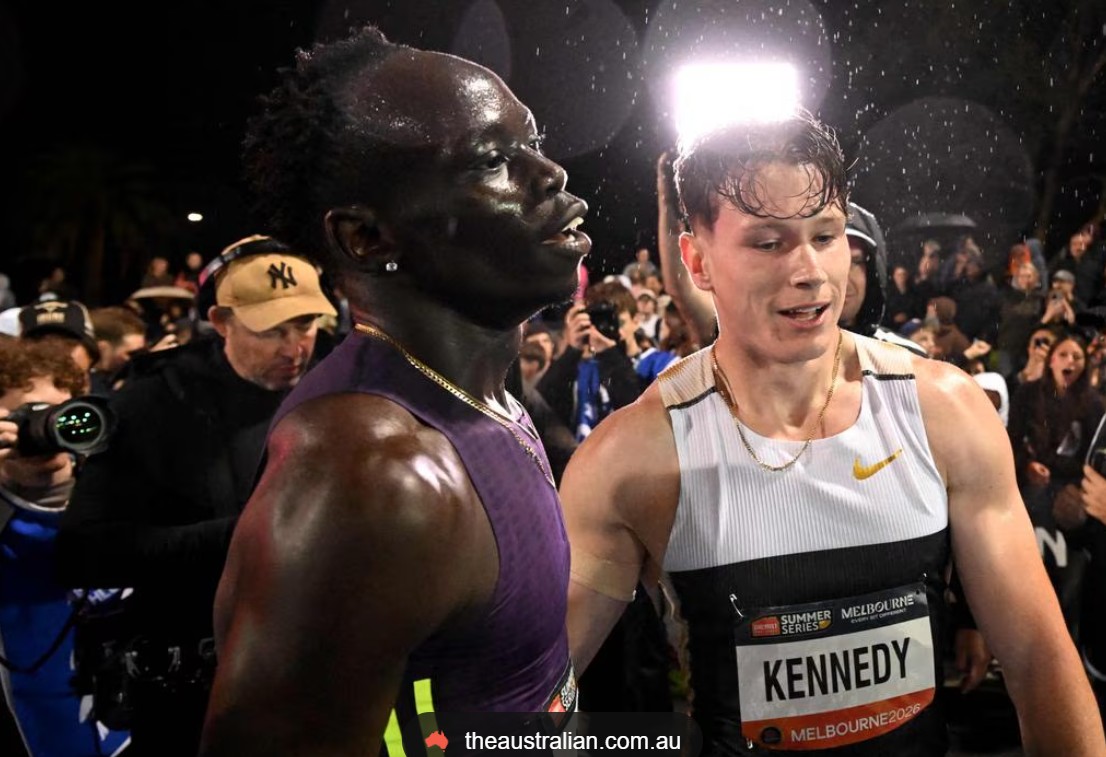


It’s time to stop seeing Lachlan Kennedy as the spoiler to Gout Gout’s ambitions at 200 metres. Instead, it’s past time to acknowledge him as a headliner in his own right.
For the second year in a row, the Peter Norman Memorial 200 metres was the show-topper at the Maurie Plant Meeting. For the second year in a row, it was previewed as the stage for Gout to stamp his credentials as the nation’s top sprinter. And, for the second year in a row, Lachlan Kennedy upstaged his fellow-Queenslander by winning ‘Gout’s race.’

Now, we should not read too much into this. In assessing the two performances there are almost as many caveats as there are metres in the race. First, it’s the Melbourne meeting, not the Olympics, nor the world championships, nor even the national championships. But, again like last year, Gout ran the 200 only while Kennedy ran, and won, the 100 earlier on the program.
In 2025, Kennedy ran 10.17 to win the 100 by over a metre from Sebastian Sultana, then went on to beat Gout in the 200, 20.26 to 20.30. This year, he was even more impressive in the 100, his 10.03 putting him two metres to the good of Rohan Browning’s 10.25. Then, in the only significant shower on a cool and damp Melbourne evening he again turned back Gout in the 200, 20.38 to 20.43.
Another caveat. As Melbourne went is not necessarily the way the national championships will go in Sydney next week (9-12 April). Look no further than last year when a resurgent Rohan Browning defeated Kennedy to win the 100 (both running 10.01) and Gout, having won the U20 100, took the senior 200 with Kennedy left forlorn at the start after being disqualified for a false start.
Nor was it the case that Gout ran badly, though his 50 metres out of the blocks was not a clip for his highlights reel! He ran well; Kennedy just ran better — and faster. At 22, Kennedy is a more fully developed athlete than Gout; he turns 23 in November, Gout 19 a month later. Each clearly has further development but it will not come in linear progression. Right now, Kennedy is ready to race all comers while Gout is feeling his way along step by step.
But we should not allow our excitement about Gout’s potential development to overshadow what Lachlan Kennedy is achieving right now. He raced to a silver medal in the 60 meters at the world indoor championships last year and became the second Australian behind Patrick Johnson to break 10 seconds when he ran 9.98 in Nairobi a couple of months later. A back injury curtailed, and ultimately derailed, his world championships’ campaign.
Drawing a line through their careers right now, Kennedy is Australia’s best sprinter. This is clearly so at 100 metres where his 9.98 is second only to Johnson’s national record 9.93. The aggregate of Kennedy’s five fastest races – 9.98, 10.01, 10.03, 10.03 and 10.07 (all with legal winds) is 50.12. Browning’s is 50.14 and Johnson’s 50.16 (again, both all wind-legal).
Gout’s youth means he cannot draw from such a deep pool, but taking his five fastest times under all conditions – 9.99w twice, 10.00, 10.04w and 10.17 – his aggregate is 50.22. Expect that to keep coming down.
As Gout and Kennedy continue their development they will probably clash several times each year. At least in the short to medium term sometimes Kennedy will come out on top, other times Gout. The competition will be to the benefit of both. With luck, it will go all the way through to Brisbane 2032.
There was much to like at the Melbourne meeting besides the clash of the sprinters. The middle-distance races are always a highlight and the victories of Cameron Myers and Claudia Hollingsworth in the two 1500s stood out even over Jackson Sharp and Rose Davies in the 3000s and Luke Boyes in the 800.
There’s a strong case for both Myers and Hollingsworth as the standout performer on the night – not to mention US visitor Jacory Patterson in the men’s 400 and Matt Denny in the discus. Myers destroyed world indoor bronze medallist Adam Spencer over the last 450 metres of the men’s 1500 while Hollingsworth was most impressive in repelling the challenge of indoor 1500 gold medallist Georgia Hunter Bell in taking the women’s race.
Myers set an Australian all-comers record 3:30.42, breaking the previous record held by Hicham El Guerrouj, if you don’t mind. He left Spencer seven seconds behind in the last 450.
Hollingsworth ran a meeting record 4:01.30 in beating Hunter Bell by just 0.22, but it was the manner in which she seized the initiative in the final lap and then found something extra to prevail over Hunter Bell’s surge in the last 50 metres that was most impressive. Given the British woman’s performances over the past couple of years, Hollingsworth just shaded Myers in my view. Ask me every day for a week, however, and it would possibly be a 4-3 split decision either way!
Nina Kennedy continued her return from serious injury with a win at 4.72 metres in the women’s pole vault, a performance which may turn out to be of greater significance than anything else at the meeting.
Thankfully, the weather was well on the better side of the worst predicted. The only significant shower was the one which fell as the men’s 200 metres field took to the track and stopped pretty much as soon as they crossed the line.
Just don’t say that Lachlan Kennedy rained on Gout Gout’s parade. He is a headline act in his own right.