




When someone experiences a huge amount of good fortune or happiness all at the same time we often say all their Christmases have come at once.
I’m not sure if all my Christmases came at once on 10 January 2026, but at least two of them did which is something to be going on with thanks very much. I woke in the morning to discover Track & Field News’ annual rankings awaiting in my inbox, then I awoke again in the middle of the night – technically 11 January, but 10 January Florida time – to learn that Australia had won the relay at the world cross-country championships.
Let’s leave the full detail of the Australians who achieved a top 10 event ranking for the moment other than to mention that two who did also ran the pivotal legs in the mixed relay. Jessica Hull ranked fourth in the 1500; Linden Hall ninth. Hall, running on the course she literally helped construct during her scholarship days at Florida State University, blew the race apart on the second leg; Hull sealed the win with a brilliant closing leg.
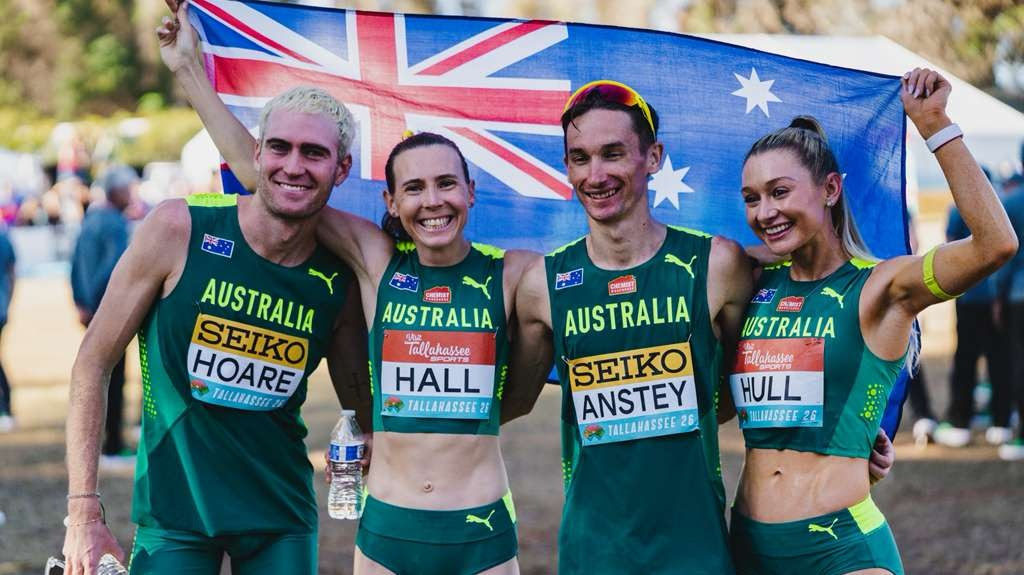
That’s not to downplay the efforts of Olli Hoare on the opening leg and Jack Anstey on the third. Hoare ensured Hall was in a position to attack when he was right on the heels of the leaders after the first lap of the 2km course; Anstey, drafted in just 10 days prior to replace Cam Myers, stoutly defended the lead Hall gifted him. With Olympic 1500 silver and world championship bronze medallist Hull on the anchor, the result was never in doubt.
Hoare and Hull are now dual relay medallists at the championships. With Abbey Caldwell and Stewart McSweyn, they made up the quartet which took the bronze medal at Bathurst in 2023. Australia now has five medals in world cross-country competition. Benita Willis has been involved in three – her individual triumph in the women’s race in 2004 and team medals in 2006 and 2008. Hoare and Hull have each been involved in the other two.
World cross-country traditionalists – of which group I would claim membership – have been slow to get on board with the mixed relay. The event was first contested at Kampala in 2017, then at Aarhus in 2019, Bathurst (2023), Belgrade (2024) and now Tallahassee. Australia’s has participated just twice, for two medals.
It’s not to downplay Jess Hull’s feelings on a second world cross-country relay medal to wonder whether the gold medal might be of greater significance to her three teammates. Jack Anstey was never in contention until Cam Myers withdrew, so he was substituted into a gold medal team. Olli Hoare has struggled – relatively, at least – to maintain the high level which took him to an Olympic final in 2021 and a Commonwealth Games gold medal in 2022. The relay gold is a significant personal achievement, all the more if it proves to be the springboard for a late-career revival.
Then there’s Linden Hall who, astoundingly, was making her world cross-country debut just a few months short of her 35th birthday. Hall played a pivotal role in bringing Australian back to the forefront of women’s middle-distance running but had always fallen short of the medals (an Olympic finalist in Tokyo and twice fourth in the Commonwealth Games). Now, she goes straight to the top of the dais.
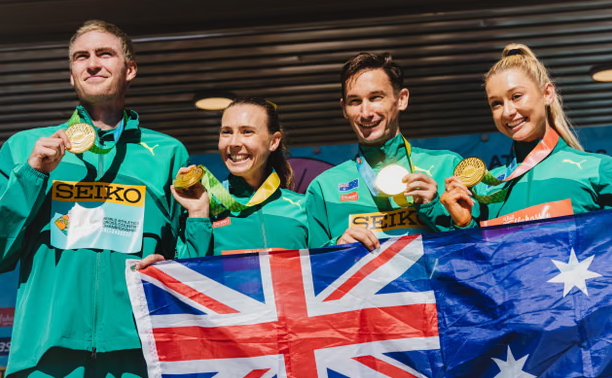
Cream is usually the last thing to go on a cake, but the relay gold in the first event on the program was the cream on Australia’s overall performance in Tallahassee. Top-20 finishes from Lauren Ryan and Leanne Pompeani – 13 and 15, respectively – led the senior women’s team to fourth place, a result matched by the U20 men, led home by Harrison Boyn in twenty-third place. Isabella Valinoti’s top-20 finish (19) led the U20 women to fifth place.
Against that, the eighth-place finish of the senior men’s team was a little disappointing, particularly as this looked the strongest team going in. But the team could match neither the senior women with two inside the top 20, nor the junior men – no-one in the top 20 but the scoring four in places 23, 25, 27 and 28.
Ky Robinson finished twenty-fourth, a place ahead of Ed Marks. Morgan McDonald (31) and Isaac Heyne (39) rounded out the scoring four with Seth O’Donnell (45) and Haftu Strintzos (54) completing the team. Tanzania and Spain were just three points ahead of the Australians, the former by dent of better packing, the latter led by a top-10 finisher.
Jacob Kiplimo joined John Ngugi, Paul Tergat and Kenenisa Bekele in winning the senior men’s race three times in a row. Carlos Lopes also won three titles, but not consecutively. Kenya’s Agnes Ngetich was a runaway winner of the women’s senior race her 42-second margin bettered only by Grete Waitz, who won by 44 seconds in 1980 when the senior women’s race distance was 5km.
Now, sadly, there will not be another world cross-country until 2029 as the championships move to an odd-year schedule. The World Athletics rationale is apparently that there is a logjam of championships in the even years which may be true but sits oddly with the decision to go with the even years which was taken after Bathurst in 2023 (originally scheduled for 2022 but delayed by Covid).
We keep hearing optimistic noises that world cross-country will be added to the winter Olympic program. We likewise keep hearing that there is a rump – perhaps a decisive number, perhaps not – of winter sports federations which remain implacably opposed.
World cross-country in the Winter Games might be plan A. But if that doesn’t get up, what the heck is plan B.
THE RANKINGS
Much as I would like to write that Jess Hull and Linden Hall’s 1500 rankings were the highlight of Australia’s performances in the annual Track & Field News lists, I cannot.
That honour would have to go to Nicola Olyslagers who supplanted world record holder Yaroslava Mahuchikh as world champion, Diamond League champion and also defeated her at the world indoor championships and at the Stockholm Diamond League meeting.
Olyslagers ranked number one for the year and narrowly missed a ranking among the top 10 athletes across all events. She was joined in the high jump top 10 by fellow-Aussie Eleanor Patterson, who was ranked third.
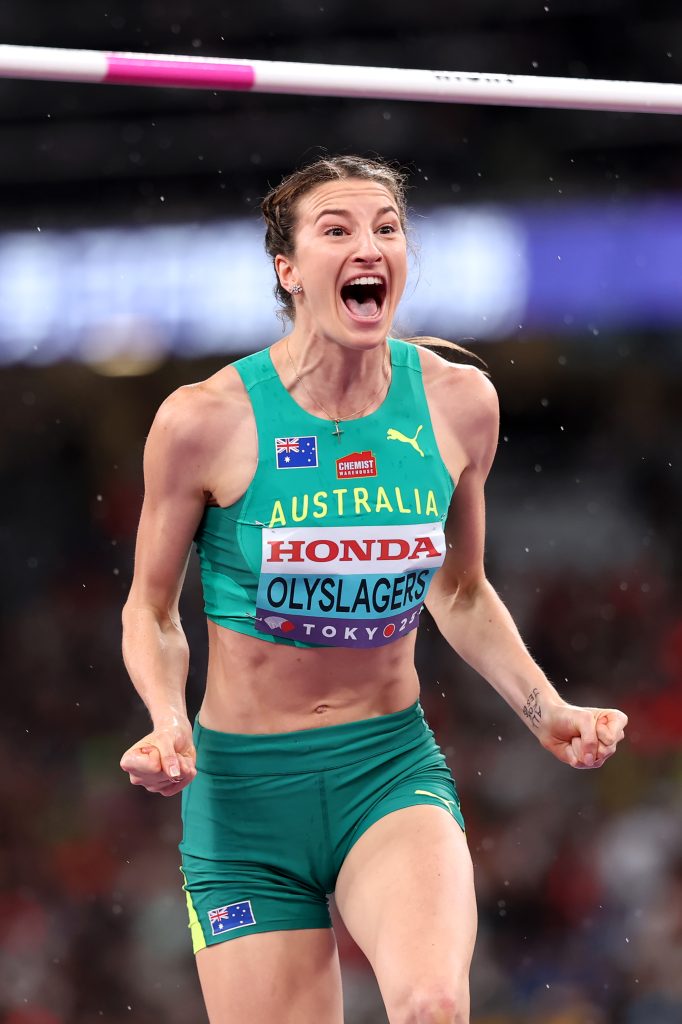
It gets even better than that. Either Hull or Hall has gained a ranking every year since Hall bwas ranked fifth in 2021. In that same period, however, Olyslagers and Patterson have both ranked in the top five each year. The sequence for Olyslagers is 3-4-2-2-1; for Patterson it goes 5-2-4-5-3. Olyslagers has won two silver Olympic medals along with her world championship gold; Patterson was world champion in 2022 and world silver medallist the following year.
Historically, that is not the best rankings return by Australians in the women’s high jump. In 1962, no fewer than four – Robyn Woodhouse, Michele Brown, Helen Frith and Carolyn Wright were in the world top 10. Brown was the most prolific of the four: an Olympic silver medallist in Tokyo in 1964, Brown ranked in the top 10 nine times, including seven in a row from 1958 to 1964.
Back to Hull, Hall and the 1500. This is the first year both have ranked in the top 10. On the men’s side, Olli Hoare (4) and Stewart McSweyn (3) both did it both in 2021 and 2022 (4, 9).
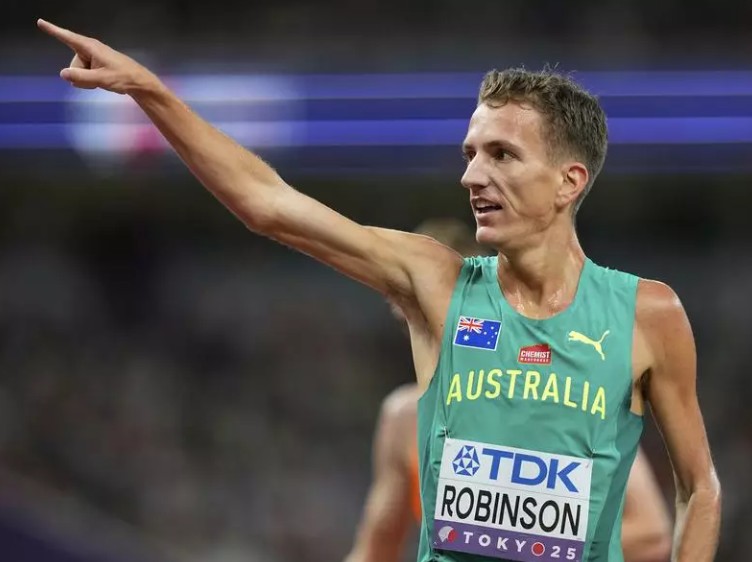
Ten Australians were accorded a top 10 ranking by Track & Field News for 2025, arresting a decline from 12 to 10 to eight over the previous three years. Ky Robinson and Liam Adcock both did it for the first time – Robinson was ninth in the 5000, the first Australian to get a ranking since Craig Mottram’s fourth in 2005, the year he was bronze medallist in the world championships. Despite his disappointment in Tokyo, where he did not make the final, Adcock was ranked fifth in the long jump, the first ranker since Henry Frayne, fourth in 2018.
Kurtis Marschall’s solid season in the pole vault, crowned with a bronze medal in Tokyo, earned him a no.3 rank. Likewise, Matt Denny was voted no.4 in the discus and Mackenzie Little no.6 in the women’s javelin.
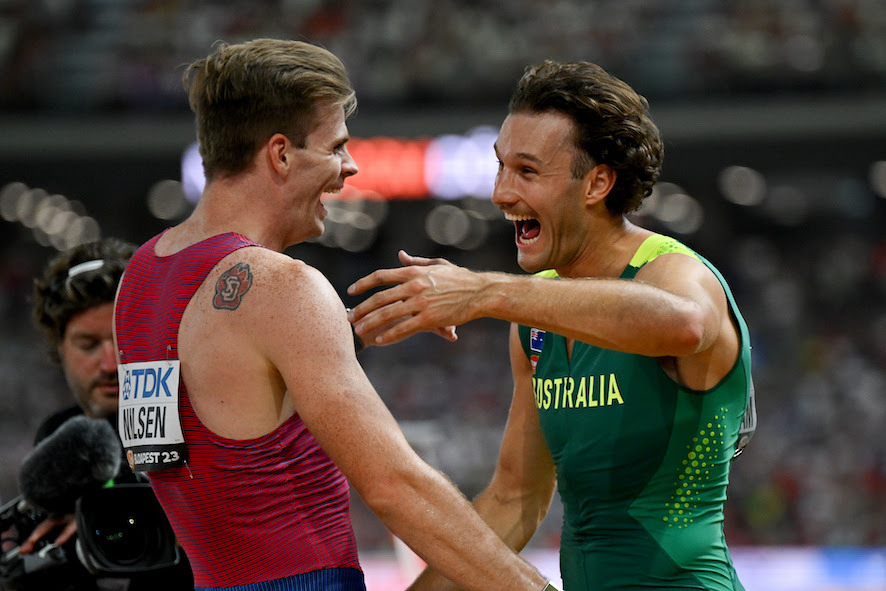
Despite a season curtailed by injury, walker Jemima Montag won two world walking tour events, enough to secure seventh in the rankings.
Montag has now ranked in the top 10 five years in a row. She still has a long way to go to match Kerry Saxby Junna, however, who ranked 12 times in succession. Little, with four top 10s, is closing in on Kelsey-Lee Barber who did it six times.
As noted, Patterson and Olyslagers still have ground to make up on Michele Brown who ranked nine times in the high jump between 1956 and 1966 while Kurtis Marschall’s five appearances trails only Steve Hooker’s six. Men’s pole vault is an ‘asterisk’ event, however: Dmitri Markov has been ranked in the top 10 seven times, but only four as an Australian; the other three were for his native Belarus.
All this comes from a rather shallow dive into the 2025 rankings. As ever, there’s a lot more to it the deeper the dive. When it comes to ranking lists, there’s always more gems waiting to be uncovered.