

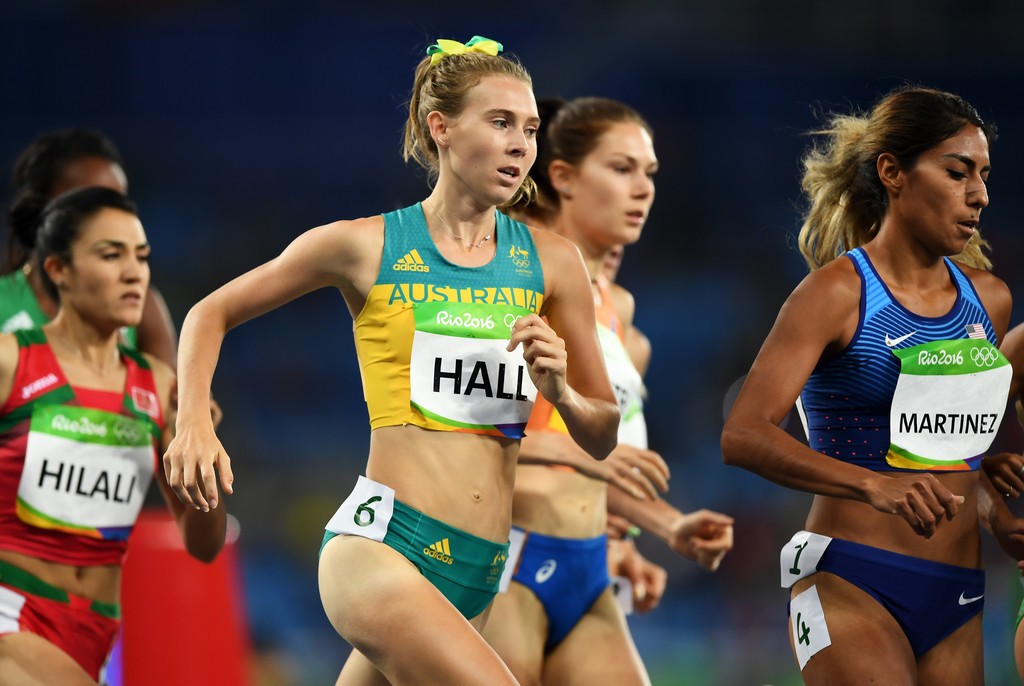


Linden Hall seems to have had the better of time just lately.
Approaching her 35th birthday, Hall shows no signs of a performance drop-off. Established as a world-class 1500 metres performer with a sixth place at the Tokyo Olympics and being the first Australian woman under four minutes, she continues to perform at the classic distance with personal bests in both the 1500 and mile last year.
Those PBs have come at the same time as Hall has made a successful transition into the longer distances. She won the 3000 metres at the Stockholm Diamond League meeting last year (her only other DL win came in the 1500 at the same meeting three years earlier) before making the final of the 5000 at the world championships in Tokyo.
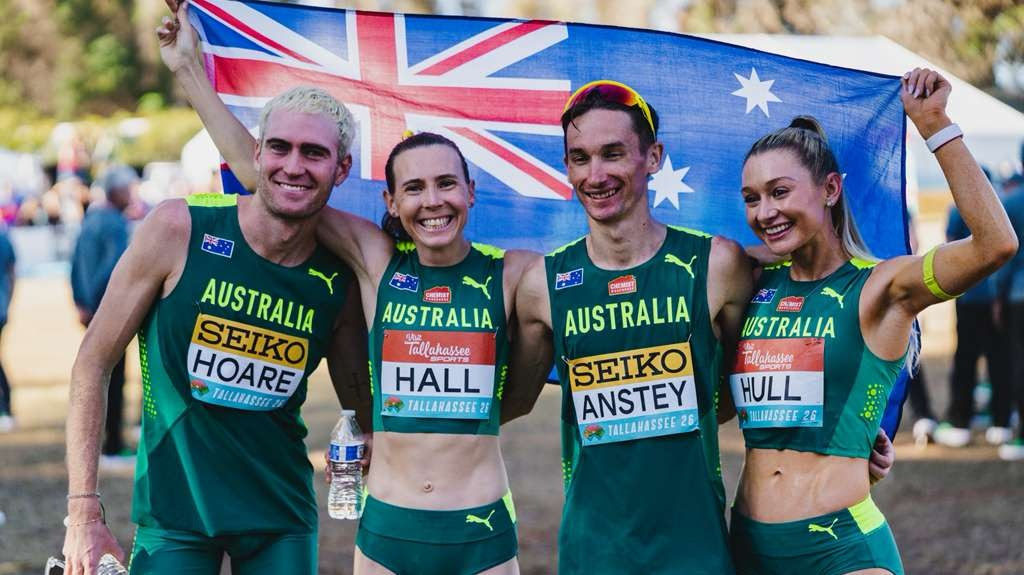
And Hall has begun 2026 at the same rapid tempo. She put Australia into a winning position in the mixed relay at the world cross-country championships in Tallahassee, running fastest time on the second leg to move from fourth at the first change into a solid lead at half-way. She lingered in the US to run in some of the big indoor meetings, running an outright personal best 8:27.03 in finishing second at 3000 in Boston on 24 January and then an indoor PB 4:21.45 in the mile at the Millrose Games six days later.
According to the World Athletics scoring tables, Hall’s 8:27.03 is the highest-ranked performance of her career. Six of her top 10 ranked performances have come since the beginning of 2025, all 10 since July 2023. Times have literally and figuratively got better for Linden Hall.
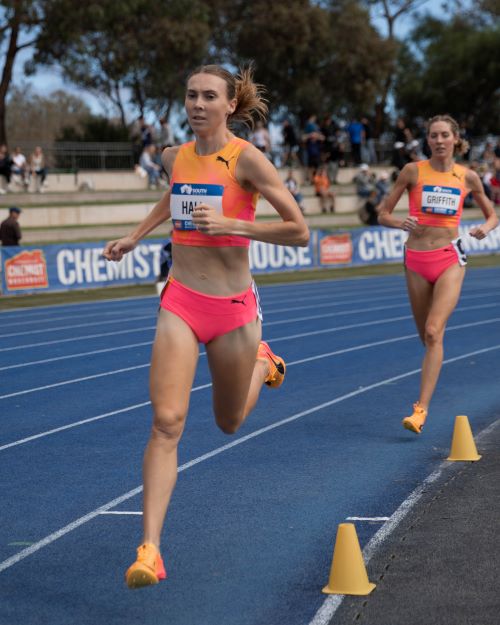
“The Moon’s a Harsh Mistress” science fiction novelist Rabert Heinlein wrote back in the 1960s (and singer-songwriter Jimmy Webb appropriated into a song title a few years later). The clock is just as capricious, if not quite as cruel. If time has been generally kind to Linden Hall these recent years, it also showed its cruel side when she raced 5000 metres at Box Hill on Thursday (19 February) this week.
On one hand (if digital clocks can be said to have hands), Hall beat the clock. On the other, the clock delivered her a mean blow.
Paced by Aussie teammate Abbey Caldwell for the first 3000 metres, chased by Japan’s Nozomi Tanaka (who finished right on the heels of Davies and Hall in Tokyo last year), Hall took the win in 14:56.04.
That represented the fastest time run by an Australian woman in Australia, clipping precisely a second-and-a-half off the 14:57.54 Davies ran in winning at the Melbourne Continental Tour gold meeting last year. But it was also a scant 1.04 seconds off the 14:55.00 Australia has set as its qualifying standard for this year’s Commonwealth Games in Glasgow.
We should note here that these qualifying times are not the same as those set for the world championships and Olympic Games. Those are set by World Athletics and the International Olympic Committee. There are no such times for the Comm Games. Nor is there an open selection. Australia has been allocated a quota of places (63, I think, but check your local guides as they say).
However, athletes winning (or first Australian) in the national championship will be guaranteed selection if they have achieved the standard. In our crowded middle and long-distance sector, athletes are going to have to be shuffled around to prevent some big names missing out on the Games (not to mention the brief joy of a Glasgow summer).
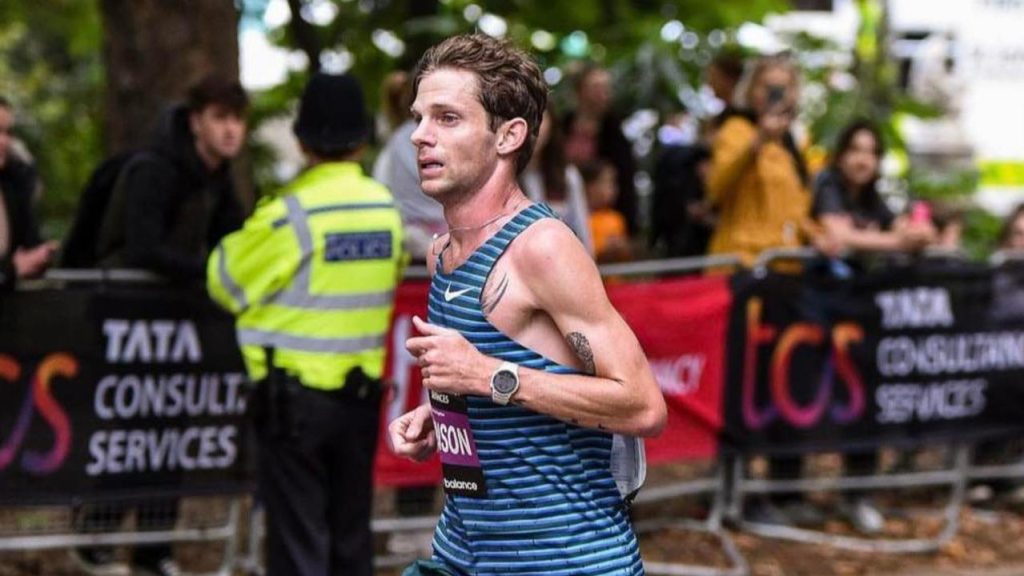
Brett Robinson’s win the men’s 5000 at Box Hill had a similar time – or distance – element. For 4400 metres, Seth O’Donnell dominated the race. In a typical O’Donnell run he led from the start, at times by 40 metres and more. But he was slowing noticeably in the final 1000 metres and caught by Robinson in the back-straight on the second-last lap. It was a two-man battle from there, Robinson prevailing in the final 60 metres, 13:28.39 to 13:29.40.
Returning to that Australian Australian all-comers record of Linden Hall’s led your correspondent to compile his own list of the top 10 5000 performances by Australian women in Australia.
After Hall and Davies, there is only one other sub-15: the versatile Izzy Batt-Doyle ran 14:59.18 behind Rose Davies at the Melbourne meeting last year. Next fastest, though considering the occasion it might be the best performance, is Eloise Wellings with 15:00.69 in fourth place in the Melbourne 2006 Commonwealth Games.
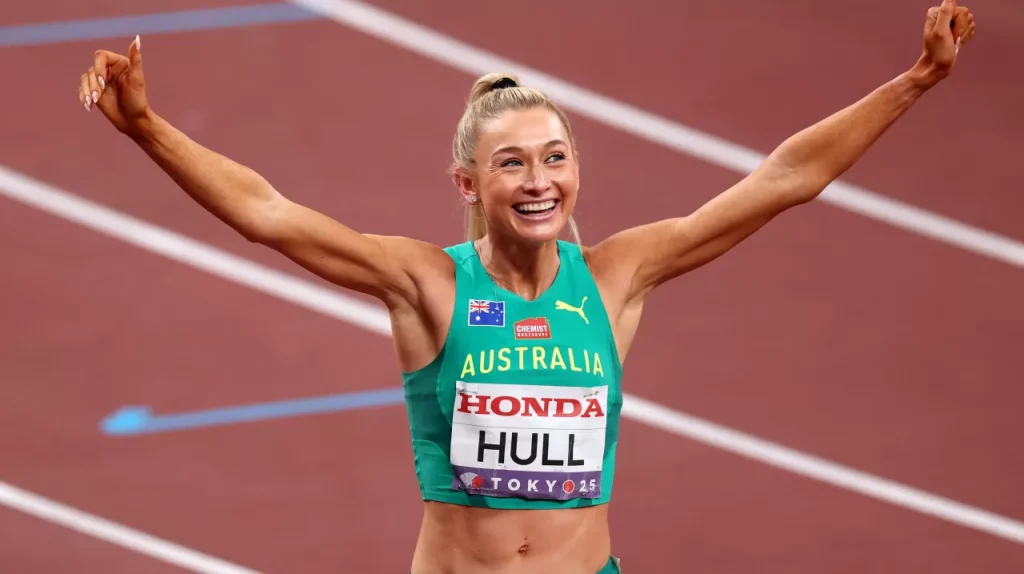
Hull occupies fifth and tenth places with two of her three national championship wins (Perth last year and her first, in Brisbane in 2023. Sarah Jamieson ran 15:02.90 in fifth place in the Melbourne 2006 final, Georgia Griffith, Davies (again) and Hall (likewise) occupy places 7-9. Slowest time in the top 10 is Hull’s 15:05.87.
All told, per World Athletics there have now been 30 sub-15 minute performances by Australian women across all venues. Besides those already mentioned, Benita Willis, Lauren Ryan, Maudie Skyring and Jenny Blundell have also got a 14-something to their name.
And all but six of those 30 have been achieved since the start of 2024. The revolution rolls on.
Her leg on the XC relay was brilliant.