



I first set foot on an indoor athletics track in Toronto in 1976. In the 50 years since I have covered Ken Elphick’s abortive indoor track series – one meeting in Brisbane before it all came crashing down – and three world indoor championships. And I still don’t know quite what to make of it.
The Toronto track is the only one on which I have done any substantial running. I was in town for a night or two catching up with a Canadian friend we had shared ship-jet travel from Perth to London, via Singapore, a few years earlier. I was looking for somewhere to run and the reception desk told me there was a track up on the top floor. Can’t recall what the surface was – beyond the fact that it wasn’t boards – nor how many laps there were to the mile, but the whole experience could only have been any weirder had the Village People walked in and burst into song!
Ken Elphick’s series of one was scarcely less unusual. Elphick had run a series of successful outdoor meetings in Australia in the late 1970s and secured sponsorship from Korean car manufacturer Daewoo for indoor meetings in Brisbane, Sydney and Melbourne. Carl Lewis signed on as a series ambassador. Lost in all the hoo-hah was whether he was ever signed up to run. Turned out he wasn’t; he would promote the events but would compete, basically, only if he felt like it.
Elphick had funds enough to procure only 120 metres of indoor track. That meant six-2/3 laps of the track to the 800, almost three laps more than four laps of the by-then standard 200 metres per lap and just short of a positively dizzying 13 laps to the 1500. Still, it was at least a track. Within a few days it had disappeared into the yard of the trucking company which had been booked to transport it to Sydney, seized as some possible recompense for the unpaid work.
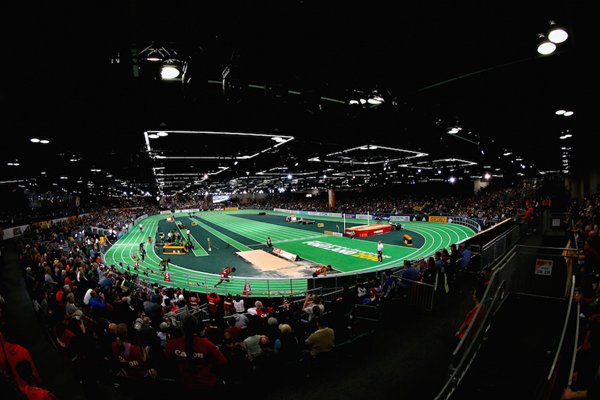 By comparison, the three world indoor championships – Maebashi, Japan in 1997, Doha in 2010, Istanbul in 2012 – were smooth sailing. We did strike choppy water, however, on arrival at Tokyo airport with our transport to Maebashi. It fell to the unlikely trio of Cathy Freeman, Colin Jackson and me to try and sort it out.
The buses were waiting for later arrivals, we gathered across the language divide. Freeman turned on the charm, however and, ‘hey presto’, one of the buses was allocated to the Australian team (plus the one media representative). There was space for the others at the airport, too, but Jackson nobly stayed waiting for teammates on the later flight. He survived the trip to win the 60 metres hurdles in championship record time.
Doha in 2010 was unusual only in the fact that it was the first – and surely will remain only? – world indoor titles at which athletes went outside to warm up. Even in what passes for autumn the temperature in the Gulf nation was around 30°C, so athletes opted for the outdoor track, laying out beach towels to bask in the sun between drills and reps.
Istanbul was pretty much all you would expect a winter event to be though, again, there was no snow or ice to be found.
What about the quality of competition then? Well, this is where I’m at a loss to assess indoor (or short track as we now have it) athletics. The entertainment value is first-class from the moment you walk in and don’t know where to look as a track event, the shot put (the only throwing event) and a vertical or horizontal jump are all going at once. At times it is like that slapstick comedy trope where the cat’s tail is swishing under the rocking chair. Except the chair rail never comes down on the tail!
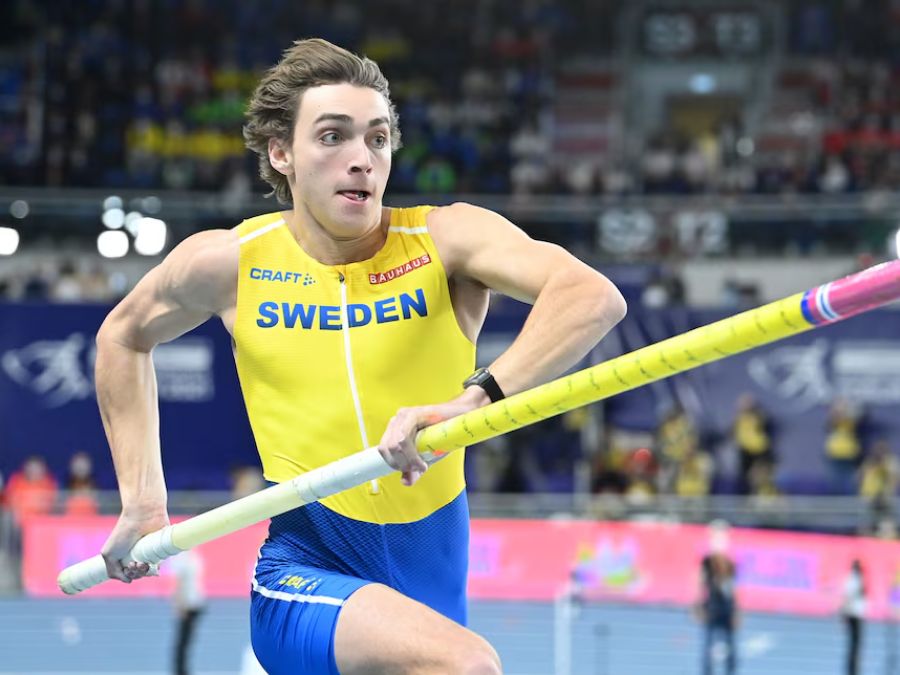
With exceptions however – a shout to Mondo here – the performances don’t really stick in your mind. When I reflect on all the indoor competitions that I’ve seen or read about, there’s not much that comes vividly back to me. Part of that is surely that Australia – along with almost half the world – doesn’t have domestic indoor competition. Even the fans, then, have no constantly-reinforced reference point of what constitutes a good 60 metres flat or hurdles performance.
Along with that, world indoor championship results get overwhelmed later in the year as the outdoor season develops. What happens in February-March is eclipsed by what happens in the Eugene, London, Paris, Monaco, Zurich or Brussels DL meetings, or the major championships later in the year.
Ron Clarke set world records indoors, but I can’t recall any of them with the same clarity as his first outdoor records in Australia, of his fabulous world records at Bislett (10,000 metres) and Stockholm (5000), or his amazing duel with Gerry Lindgren over three miles in London. When I listed some of our successful indoor performers a few weeks back, former Australian Athletics president Terry Dwyer reminded me that Al Lawrence had set indoor world records at 2 and 3 miles in the 1960s. Point taken, but are they more widely remembered than his bronze medal behind Kuts in the Melbourne Olympic 10,000?
None of which is to deny the atmosphere and entertainment of indoor athletics. It’s a huge buzz, a sugar-hit if you will. So, I will be watching attentively as two-time defending champion Nicola Olyslagers and Eleanor Patterson take on world record holder Yaroslava Mahuchikh tonight in the women’s high jump as the world indoor championships get under way in Torun, Poland.
Pass the sugar, please, I feel like I’m about to need an extra spoonful.