

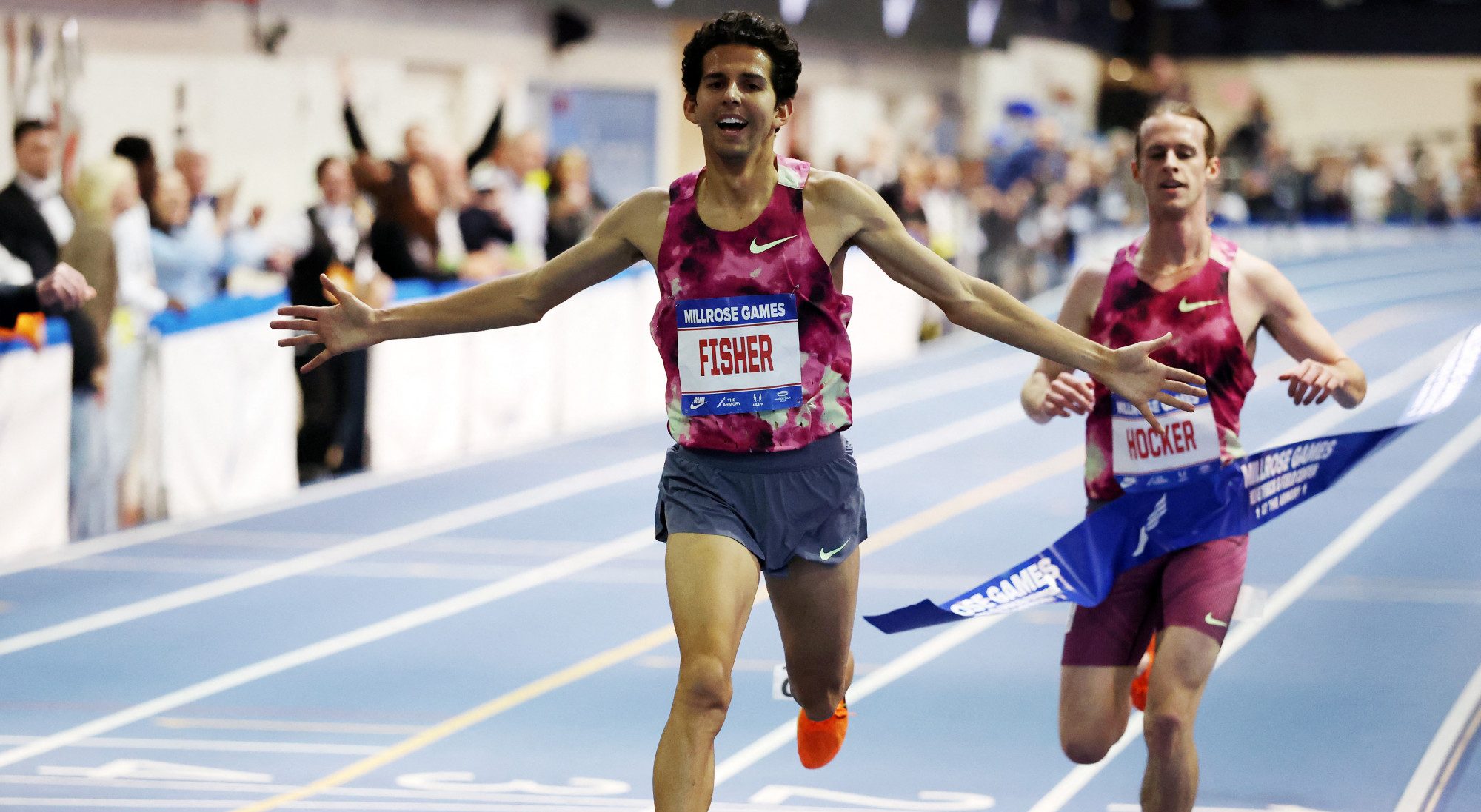


Sunday 24 January 2026, Boston, and for the second time in two years two male Americans set world records at the same indoor meeting.
In 2025, at the Millrose Games meeting held in the New York Armory (apt venue for explosive performances!), Grant Fisher ran 7:22.91 for 3000 metres, eclipsing the previous world mark. Olympic 1500 champion Cole Hocker was second, also beat the previous record.
Then, Yared Nuguse ran 3:46.63 for a world record for the indoor mile. Hobbs Kessler finished second, also under the record previously held by Yomif Kejelcha.
A week later, this time at Boston’s The Track at New Balance, Fisher took down Kenenisa Bekele’s 5000 indoor world record with a 12:44.09 performance.
Fast forward to this year’s Boston meeting held last Sunday (24 January). Now it was the turn of Hobbs Kessler, fourth in the Paris24 Olympic 1500 final. Kessler sped around the Boston track in 4:49.79 to clip two tenths of a second off Kenenisa Bekele’s world record 4:49.99. Fisher was also under the previous record in second place.
The last word – until this weekend’s Millrose Games at least – went to Josh Hoey who ran 1:42.50 seconds to win the 800 metres, taking 0.17 off Wilson Kipketer’s mark set back in 1997.
Jonathan Gault at LetsRun cast his analytical eye over this record-breaking, both this year and last. Sure, people are running faster (the mile record lasted only as long as Jakob Ingebrigtsen’s next race, for example). Yes, shoe technology; ditto, fast tracks and bicarb(onate of soda, that is) are all helping athletes run faster.
But Kessler and Hoey both missed the US team for last year’s world championships in Tokyo. Much as this may demonstrate the depth of competition in the US at the moment, Gault went on to state that “Kessler and Hoey are not Bekele and Kipketer.
“But they ran damn fast on Saturday — especially Hoey,” Gault continued. “Other than Kipketer in 1997, no one else has even come within a second of Hoey’s time indoors . . . .
“On the global scale, they are not generational talents like a Kenenisa Bekele or Wilson Kipketer. They are great runners in great shape, taking advantage of great opportunities to run fast.”
To paraphrase Monty Python’s The Life of Brian then, neither Hoey nor Kessler is the Messiah, they’re just very good runners.
It’s always difficult to know what to make of indoor performances – even before the advent of the now standard 200 metres track with banked turns. Boston, for example, has turned out a mouth-wateringly deep collection of fast times in a short time and then there’s non-standard venues like the Seattle Dome where Cam Myers went sub-3:50 for the mile which is just over 300 metres to the lap.
For a start, not everyone runs indoor track. Over half the world – Australia included – has no indoor facilities. No need for them where the climate is moderate enough to train outdoors all year round. As Gault points out elsewhere in his piece, David Rudisha never ran an indoor race. Neither has Joshua Cheptegei. Nor Emmanuel Wanyonyi. In contrast, the likes of Fisher, Cole Hocker, Hoey, Nuguse and Kessler have taken dead set aim at the major US indoor meetings these past two years, so much so that all passed up the chance to run a home world cross-country.
And tracks are faster, almost all of them tailor-made for speed. Certainly they’re far superior to the 11-laps-to-the-mile board tracks on which most north American competition was run in earlier eras.
Australia athletes have had very limited opportunities to run indoor competition before recent years. Back in the 1950-2000 era a trip to the US (mainly the US) entailed time off work and away from the Australian domestic season and then required a rapid adjustment to tight turns and bouncy, board surfaces.
Despite that, significant number of Australians gave it a go. Ron Clarke included a February trip to the US indoor circuit almost every year of his international career. He set several indoor world records (which were not formally recognised in his day). So, too, did steeplechaser Kerry O’Brien and Mexico City 1968 Olympic 800 champion Ralph Doubell.
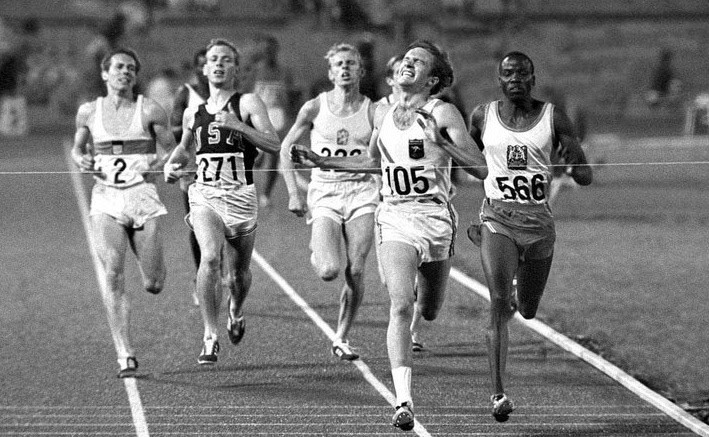
Clarke and O’Brien, both of them tall and strong-bodied, were two of those who belied the myth that indoor racing was best suited to the smaller, nimbler runners. Forty or so years later, Craig Mottram was another to break the mould.
From the 1950s onwards there was also an influx of Australian athletes attending US colleges who raced indoors. One standout was Kerry Pearce who went to the University of Texas and set world records for two miles in competition against, among others, Clarke, O’Brien and a young Frank Shorter.
Latterly, Cam Myers, Olli Hoare, Jess Hull and Linden Hall have been among numerous Australians flying the flag indoors. Mostly the Aussies find it easier to fit in with indoor meetings on the US East Coast, but the advent of the world championships has presented further regular opportunities for indoor competition. Australia ranks 15th on the overall medal table in world indoor competition, 13th on the outdoor championships’ medal tally.
It seems that the lack of facilities and limited competitive opportunities are no more insurmountable obstacles than tight board tracks were to the likes of Clarke, O’Brien and Doubell.