

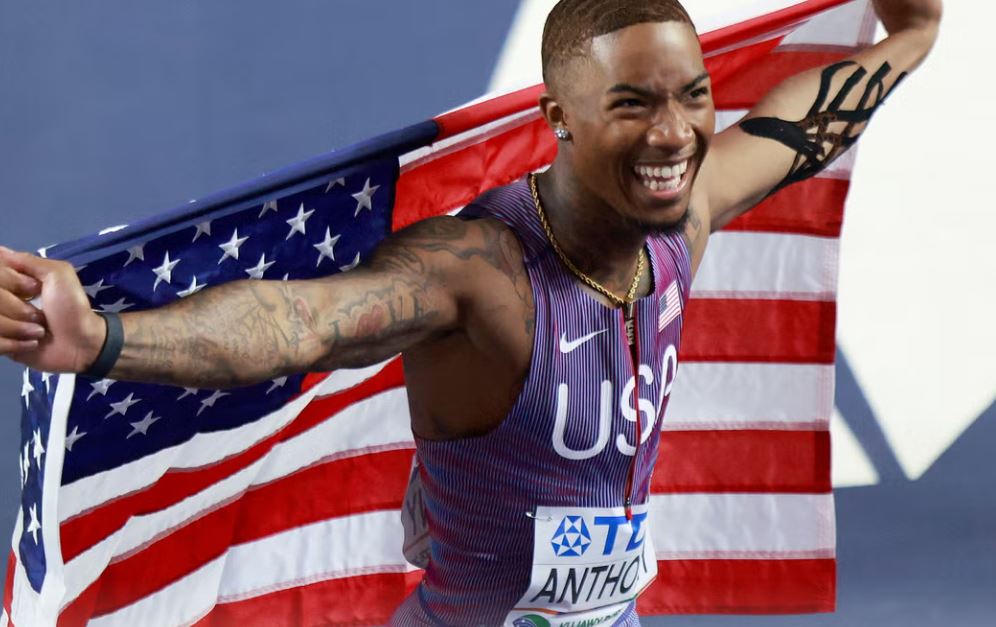


Written by RT Johno
The blocks were cold beneath his fingertips. Around him, the Hala Mistrzów arena in Kujawy Pomorze hummed with the compressed energy of a crowd that had come to witness speed — the rawest, most elemental expression of what the human body can do. Eight lanes. Eight men. Sixty metres of polished track between the starting line and whatever history had waiting at the other end.
Jordan Anthony settled into his stance, and for a moment, consider what that meant. Twenty-one years old. A kid from America who, less than a year ago, was lining up in a football huddle as a wide receiver, reading defensive coverages, running routes. A kid who had never raced at a global championship in his life. And yet here he was, in the final of the men’s 60 metres at the World Athletics Indoor Championships, with seven of the fastest human beings on the planet crouched in lanes beside him.
He had told anyone who would listen what he planned to do. “I am not going to sugarcoat it,” he had said in the days before the championships. “Why not break it at the world stage where I am basically racing the world?” The it he was referring to was Christian Coleman’s 6.34 world record — a mark that had stood since 2018 and that the sport had treated as something approaching untouchable. Anthony, apparently, had not got the memo.
The gun fired. The arena erupted. And inside eight seconds, the sport had a new world champion.
The Making of a Phenomenon
To understand Jordan Anthony, you have to understand how unusual his path has been — even by the unusual standards of elite athletics. College football in the United States is a pressure cooker. The crowds are enormous, the stakes feel enormous, and wide receivers live and die by moments of concentration under duress. Routes must be precise. Hands must be reliable. Fear is not an option.
Anthony played that sport at a high level before walking away. The reasons, as with most major career pivots, are probably layered. But the results speak to what those years on a football field gave him: composure under pressure, explosive starting ability, and a competitive instinct that doesn’t flinch when the moment is biggest. Track, it turns out, fit him like it had always been waiting.
His final college year produced an NCAA championship. His first serious season as a pure sprinter produced a US 60m title. And his US title didn’t come against ordinary competition. He beat Noah Lyles — the Olympic 100m champion, the most celebrated American sprinter of the current era — running 6.43 for what was, at the time, a world-leading mark. The running world took notice. Some were cautious, noting the youth, the novelty, the dangers of projection. Anthony himself had no such caution. He had already identified Coleman’s record as his target and was making no effort to disguise the ambition.
Then Trayvon Bromell ran 6.42 in the World Athletics Indoor Championships semifinal, and Anthony recalibrated in real time. “OK, right,” he said, in the understated way that truly confident athletes have, “now I need to run faster.”
He did.
The Final: Eight Seconds of Brilliance
In the minutes before the men’s 60m final, Anthony had a quiet conversation with Antonio — the coach of Trayvon Bromell. His message was simple and almost disarmingly candid: Bromell would set the pace in the early metres, and Anthony would follow. It was the kind of tactical transparency that only works if you genuinely believe your finishing speed is superior to everyone else in the field.
Bromell, the veteran, the man who had won this exact title in Portland, Oregon, ten years earlier, duly led through the drive phase. Then Anthony came.
The final time: 6.41 seconds. A new world-leading mark. A world championship gold medal on his global debut. Behind him, Kishane Thompson of Jamaica clocked 6.45 for silver — a personal best. Bromell matched that time for bronze, separated from Thompson by the finest margins the photo finish cameras can measure. Defending champion Jeremiah Azu of Great Britain ran 6.46 in fourth, desperately close to the podium, unable to replicate the 6.45 personal best he had set in the semifinal.
Emmanuel Eseme of Cameroon, who had equalled the Cameroonian national record of 6.52 in the semis, finished fifth in 6.58. Taymir Burnet of the Netherlands was sixth in 6.61. Bryan Levell of Jamaica — the world 200m bronze medallist — was seventh. Belgium’s Simon Verherstraeten did not finish and required medical attention on the track, the final’s one dark note in an otherwise extraordinary evening.
Anthony crossed the line and seemed, in the first moments, almost serene. The arena was wild around him. He absorbed it differently than most might have expected.
“The atmosphere is easier than college football,” he said afterward, with a grin that suggested he genuinely meant it. “Winning the gold feels great but, to be honest, I feel more excited for the fans than for myself.”
He paused. Then, as if to make sure nobody missed the point: “The final was a great race, but I still have a lot left in the tank. Most importantly, I did my debut right and I am bringing the gold medal back to the USA.”
And then, the line that may define his career going forward: “This felt easy for me. This proves to me I picked the right sport.”
The Ghost of Portland: Bromell and the Decade Between
Stand in the Hala Mistrzów on the night of March 20, 2026, and you were watching two stories simultaneously. The first was Anthony’s — breathless, meteoric, full of the raw joy of a talent that doesn’t yet know its own ceiling. The second was Trayvon Bromell’s, and it stretched back a full decade to a different indoor championships, in a different city, on a different continent.
In Portland, Oregon, in March 2016, Bromell was roughly the same age Anthony is now. He was young, unpolished, and impossibly fast. He won the World Indoor 60m title and looked like a man who would own the event for years. Instead, what followed was one of sport’s most brutal sagas of injury and perseverance.
Later that same year — 2016 alone — Bromell required two achilles tendon surgeries. The second came after he dove across the finish line in the 4x100m relay at the Rio Olympics, an act of desperate athleticism that appeared to secure a bronze medal for the United States. The team was subsequently disqualified for an illegal baton change. The sacrifice of his body had counted for nothing. The recovery that followed was long, grinding, and uncertain.
The sport gave Bromell back what it could, in instalments. Two world 100m bronze medals came eventually. And then, at the 2025 World Championships in Tokyo, the relay redemption he had been owed for nine years: a 4x100m gold medal for the United States. By the time he arrived in Kujawy Pomorze, Bromell was carrying ten years of scars and the particular dignity of someone who has refused, repeatedly, to let injury define his legacy.
A bronze medal, then, beside a 21-year-old prodigy who ran 6.41. Bromell looked at Anthony on that podium and saw something specific.
“It is a blessing to come back after so many injuries and win another world indoor medal after 10 years,” Bromell said. “Looking at Jordan, I see a mirror image of myself from 10 years ago. I also won the world title as a young, unpolished athlete. You do not see too many talents like him. It is athletes like him that keep me motivated and on top of my game.”
The generational resonance of that moment — the 2016 champion watching the 2026 champion take the gold that was once his — was one of those things athletics occasionally produces that transcends sport. It was not melancholy. Bromell seemed genuinely lifted by it. He had become, in some sense, the living proof that the story doesn’t end with injury, and here was the young man who would carry the torch forward showing exactly the kind of talent that makes carrying torches worthwhile.
Thompson: The Silver That Keeps Building
It would be easy, in the rush to celebrate Anthony’s extraordinary emergence, to gloss over what Kishane Thompson accomplished in Poland. That would be a mistake.
The Jamaican sprinter ran 6.45 for silver — a personal best, and another global championship medal to add to a collection that is becoming one of the most consistent in modern sprinting. Thompson took silver at the Paris Olympics in 2024. He took silver at the 2025 World Championships. And now silver here, indoors, against the fastest field ever assembled over 60 metres.
There is a particular kind of athlete who accumulates these results — always in the conversation, always on the podium, always running faster than almost anyone in history, and yet perpetually behind one man or another who has the race of their life on the day that matters. Thompson is 23 years old. The outdoor season awaits. The 100m world record of 9.58, Usain Bolt’s seemingly eternal mark, may feel distant, but the 9.8x range is not. And Thompson has a way of arriving at major championships in progressively better shape.
His 6.45 here was the fastest he has ever run indoors. It was only good enough for silver. That says something about the standard Anthony has set, and it says something about Thompson’s quality that he ran it anyway.
Azu’s Near Miss and the Cruelty of Hundredths
For Jeremiah Azu, the defending champion, Poland was a night that will require time to process. The Welshman ran 6.45 in his semifinal — a personal best — and would have been forgiven for believing that time might be enough to defend his title. In the final, he produced 6.46. A single hundredth of a second separated him from bronze. He finished fourth, empty-handed, in a race he arrived at as champion.
This is athletics in its most unsparing form. Azu ran beautifully. He ran faster than almost every sprinter in the world has ever run over 60 metres. It was not enough. That is the nature of the event when generational talent arrives in the same room.
Coleman’s Record: The Next Frontier
The number that sat in the background of everything in Kujawy Pomorze was 6.34. That is Christian Coleman’s world record, set in 2018, and it has served as the outer limit of what sprinting can produce over the distance. Eight years is a long time for a world record to survive in the sprint events, where technological and training advances have nudged marks in the 100m and 200m.
Anthony ran 6.43 for the US title. He ran 6.41 for the world title. The trajectory is pointed in one direction. He has made his intentions explicit, publicly and without embarrassment. The world record, he believes, is available to him — not someday, but soon, and ideally at the kind of stage where breaking it would mean the most.
How realistic is that assessment? The drop from 6.41 to 6.34 is seven hundredths of a second. In sprint terms, that is not a trivial gap — Coleman’s record is genuinely exceptional. But Anthony ran 6.41 and said it felt easy. Bromell, who knows something about exceptional sprinting, watched Anthony race and offered no pushback on the idea that greater things are coming. The world record conversation is no longer premature.
A Broader Evening of Excellence
The 60m final was the emotional centrepiece of the evening session in Kujawy Pomorze, but the night produced excellence across the board.
In the men’s triple jump, Andy Diaz Hernandez of Italy confirmed his status as the dominant force in the event. The Olympic bronze medallist opened with a world-leading 17.47m in round one and his rivals never came close. It was his second consecutive World Indoor triple jump title — the first back-to-back winner in the event since 2004. Jordan Scott of Jamaica took silver with 17.33m, Yasser Triki of Algeria bronze with 17.30m.
In the women’s shot put, Chase Jackson of the United States stood alone. She was the only athlete in the field to surpass 20 metres, launching the shot to 20.14m to claim gold. It completed the full set of world indoor medals for Jackson, and made her only the second American woman to win this title — following Michelle Carter’s victory in 2016, the same year Bromell took his first world indoor crown. Sarah Mitton of Canada was silver with 19.78m, Axelina Johansson of Sweden bronze with 19.75m — a Swedish national record.
In the men’s heptathlon, Simon Ehammer of Switzerland holds the overnight lead, but American Kyle Garland — who cleared 2.14m in the high jump — sits just 13 points back. A world record could be in play on Day 2. In the 400m, Christopher Morales Williams and Khaleb McRae — the two fastest men in history indoors over the distance — won their respective semifinals in 45.35 and 45.39, setting up a final that may produce something historic. In the women’s 1500m, Georgia Hunter Bell and Jessica Hull both advanced, while in the men’s equivalent, world champion Isaac Nader of Portugal and Mariano Garcia of Spain progressed with the authority of title contenders.
It was, by any measure, a first day of finals that delivered on every promise the sport had made coming in.
What Comes Next
Jordan Anthony will fly home to the United States with a gold medal and a world-leading time and a quote for the ages — “This proves to me I picked the right sport” — and the outdoor season will begin its approach. The 100m. The 200m. Diamond League circuits. And, eventually, another championship somewhere, where the question of what he is truly capable of will be asked again.
He is 21. He played college football six months ago. He is the fastest man in the world indoors this year. He has told the sport he is coming for a world record that has stood for eight years, and nothing in his two days in Poland gave anyone grounds to doubt him.
Trayvon Bromell, the man who was him once, looked at him from the bronze medal position and felt something that looked a lot like hope. Ten years, two achilles surgeries, a disqualification in Rio, and a relay gold in Tokyo — Bromell has lived the full arc of a sprint career, the brilliant beginning and the long rebuilding and the hard-won redemption. He looked at Anthony and saw the beginning of something similar, except perhaps without the detour.
“You do not see too many talents like him,” Bromell said.
In Kujawy Pomorze, on a cold March evening in northern Poland, the sport may have just glimpsed its immediate future. It runs 60 metres in 6.41 seconds, says it was easy, and is already thinking about running it in 6.34.
World Athletics Indoor Championships, Kujawy Pomorze, Poland — March 20, 2026.