



Written by RT Johno
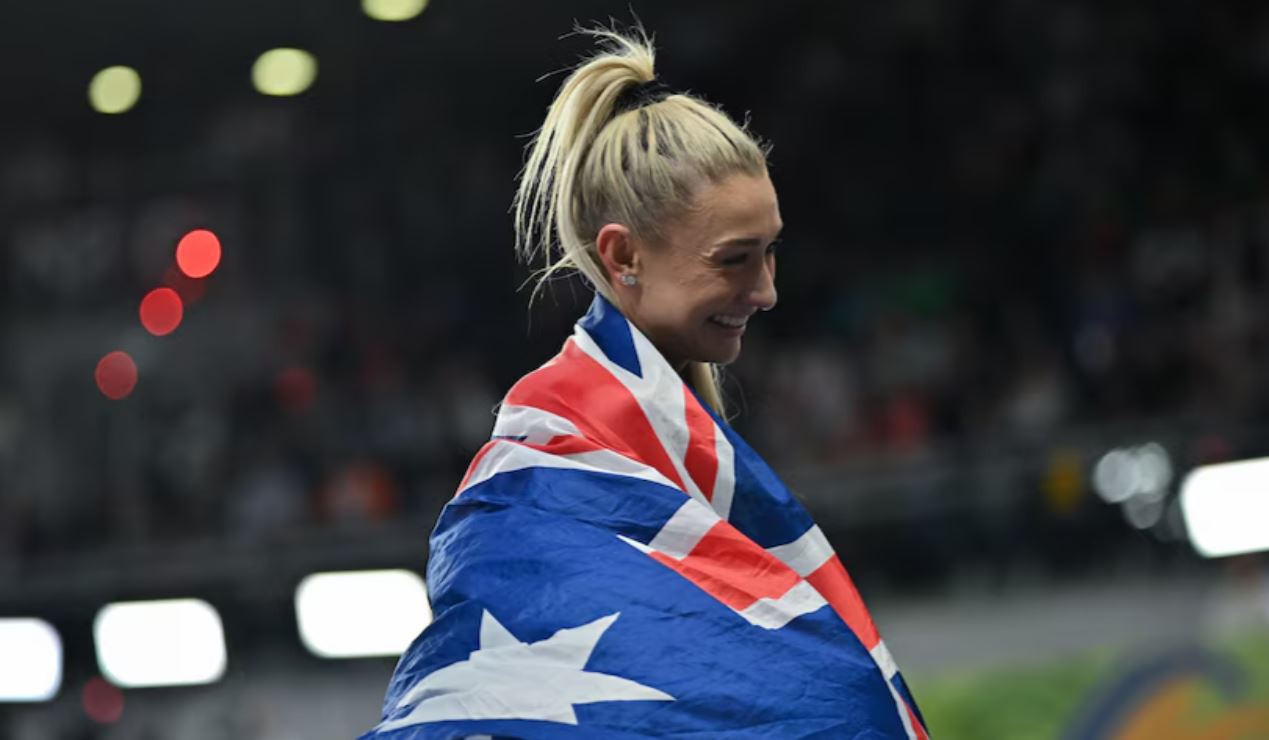
Jessica Hull has cemented her status as one of the most consistently brilliant middle distance runners on the planet, claiming silver in the women’s 1500 metres at the World Athletics Indoor Championships in Toruń, Poland, while simultaneously etching her name into the record books with a stunning sub four minute performance.
The 29 year old crossed the line in 3:59.45, becoming the first Australian woman, and the first athlete from Oceania, to break through the four minute barrier indoors, shattering her own national record set earlier this season. It was a landmark moment for Australian middle distance running, arrived at in extraordinary fashion: Hull delivered the performance less than 24 hours after winning bronze in the 3000 metres at the same championships.
Her silver came behind Great Britain’s Georgia Hunter Bell, who set a 2026 world lead of 3:58.53. The margin was just 0.92 seconds, a heartbeat in the context of a global championship final, but enough to again deny Hull the gold medal she has come agonisingly close to on multiple occasions. American Nikki Hiltz surged to bronze in 3:59.68, also breaking four minutes for the first time.
History in the Making
The sub four minute indoor 1500m is a barrier that has defined a generation of elite women’s middle distance running. For an Australian woman to crack it for the first time, on the biggest stage in the sport, in a championship final, speaks to just how far Hull has elevated herself among the world’s best.
Hull’s trajectory has been remarkable. The University of Oregon graduate and two time NCAA individual champion has steadily built from a promising collegiate career into a genuine world championship level performer, earning respect not just for her times but for her ability to race with intelligence, composure, and devastating finishing speed. That she was able to back up from a 3000m bronze the previous evening and still produce the fastest indoor 1500m ever run by an Australian woman says everything about where she is right now.
Far from being deflated by another near miss at gold, Hull was bullish and upbeat after the race.
“I think we might see a few more people try the double now!” she said. “I really enjoyed doing both, it takes the pressure off everything being emphasised on one race which at this time of year with a long year of racing ahead is really nice.”
A Championship to Remember for Australia
Hull’s double medal was one of the centrepieces of an exceptional Australian performance across the three days in Toruń. The green and gold collected five medals in total: two silver and three bronze, a remarkable return from an 11 strong team that punched well above its weight on the global stage.
Nicola Olyslagers, seeking a rare third consecutive world indoor high jump title, came within a whisker of gold before settling for silver with a clearance of 1.99m. Ukraine’s Yaroslava Mahuchikh took the top honour at 2.01m, while Serbia’s Angelina Topic shared silver with Olyslagers. For the 27 year old, who had claimed indoor gold in Glasgow (2024) and Nanjing (2025) and added outdoor world gold in Tokyo last year, the result extended one of the most consistent championship records in the event’s history.
Kurtis Marschall continued his own remarkable run of global medals, claiming pole vault bronze with a clearance of 6.00m. The three time Olympian, who had also won bronze at the 2023 and 2025 outdoor world championships, competed in one of the most stacked fields the event has ever seen. Sweden’s Mondo Duplantis was in a class of his own at 6.25m, with Greece’s Emmanouil Karalis taking silver at 6.05m.
Fellow Victorian Adam Spencer added his own piece of championship folklore, claiming bronze in the men’s 1500m in 3:40.26. The former Wisconsin Badger, who made his name competing in US college athletics, produced a stunning tactical race, sticking firmly to the rails throughout the contest while his rivals traded blows, then finding a gap when it mattered.
“The plan was to stay on the rails, which is a bit risky,” Spencer said. “I just stuck to it and was super patient, and when the gap opened up, I just sent it! Hopefully I make more finals and win more medals. There will be more opportunities and I just need to make the most of them.”
Spain’s Mariano Garcia took gold in 3:39.63, his second World Indoor title after winning the 800m in 2022, with Portugal’s Isaac Nader claiming silver in 3:40.06. The top six finishers were separated by just over a second, making Spencer’s bronze all the more impressive given the chaos and contact that typically characterise indoor championship 1500m racing.
Bol’s Australian Record Falls Short of a Medal
Peter Bol was another Australian to push deep into his reserves in Toruń. The West Australian produced a new Australian short track 800m record of 1:45.14 in the final, a genuinely excellent time, but found himself unable to hold on to a medal position as American teenager Cooper Lutkenhaus stormed to gold in 1:44.24. Lutkenhaus, just 17 years and 93 days old, became the youngest individual world champion in track and field history, indoors or outdoors, surpassing Ethiopian Mohammed Aman’s record from 2012. Belgium’s Eliott Crestan took silver in 1:44.38 and Spain’s Mohamed Attaoui claimed bronze.
For Bol, a man who has experienced more than his share of heartbreak in recent years, the national record and fourth place finish in his first global final since 2021 was a reminder of his continued quality, even if a first global individual medal remains elusive.
In the women’s 800m, Hayley Kitching gained invaluable experience in her first major final. Kitching finished fifth in 2:00.50, finding the pace set by Britain’s Olympic champion Keely Hodgkinson well beyond reach on the day. Hodgkinson was extraordinary, clocking 1:55.30 to claim gold in the second fastest indoor time in history behind her own world record of 1:54.87, completing a remarkable day for British athletics as Hunter Bell and pole vaulter Molly Caudery also struck gold.
Australian long jumper Liam Adcock, the defending World Indoor bronze medallist from Nanjing, was unable to replicate his 2025 heroics, finishing outside the medals as Portugal’s Gerson Baldé produced a world leading 8.46m in the final round to claim a stunning gold. Italy’s Mattia Furlani took silver and Bulgaria’s Bozhidar Saraboyukov bronze.
Five Medals and a Statement of Intent
When the final tallies were counted, Australia’s five medals placed them among the top performing nations of the championships. It was a result that validated the depth of Australian middle distance and track athletics and set an exciting tone for the outdoor season ahead.
Gold remained elusive across all five medal performances, a theme that has followed Hull specifically throughout her career at major championships, from the Paris Olympics to the outdoor world titles. But Hull’s mentality is not one of grievance or frustration. She is a competitor who understands the compounding nature of excellence, that consistent podium appearances at the highest level are the foundation upon which a gold medal moment is built.
With the outdoor season looming and Hull arriving at it in the form of her life, the world record of 3:49.11 set by Kenya’s Faith Kipyegon remains the benchmark, but the ceiling for what Jessica Hull can achieve has never looked higher. The first Australian woman to run sub four indoors is just getting started.
Australian Medallists at the 2026 World Athletics Indoor Championships
Silver: Jessica Hull (1500m, 3:59.45), Nicola Olyslagers (High Jump, 1.99m)
Bronze: Jessica Hull (3000m, 8:58.18), Kurtis Marschall (Pole Vault, 6.00m), Adam Spencer (1500m, 3:40.26)
Source: Australian Athletics, World Athletics, AAP