



Written by RT Johno
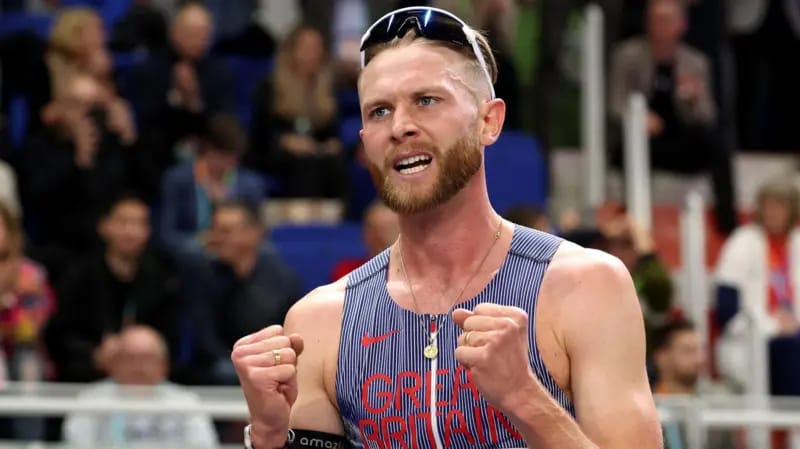
Six months after hobbling off a Tokyo track on crutches, Josh Kerr stood atop the global podium once more. The Scottish middle-distance star delivered one of the most emotionally charged performances of his career at the World Athletics Indoor Championships in Nové Město nad Metují, Poland, reclaiming his 3000m title in a time of 7:35.56 and cementing his reputation as one of the most mentally formidable runners on the planet.
Kerr, now 28 and a three-time world champion, won the same title on home soil in Glasgow two years ago. But Saturday’s performance carried a weight that gold medals rarely do. Just six months earlier, in the 1500m final at the Tokyo World Athletics Championships, Kerr sustained a grade-two calf tear in circumstances he has since described as a “freak accident” — an overstretch at the end of his semi-final that silently loaded the muscle before it gave way in the medal race. Rather than stop, he hobbled to the finish line, almost certainly compounding the damage. The road back was long, painful and, for a period, deeply uncertain.
A Family Comeback
What made Kerr’s rehabilitation remarkable was not just its speed — it was the person doing much of the early work. His mother doubles as his physiotherapist, and she was among the first to help him take his initial steps back toward fitness after Tokyo. She was also in the crowd in Poland to watch her son cross the line as world champion again.
“From where we were in Tokyo to right now, having another world gold medal, that’s all down to coaching, it’s all down to my physio and my mum,” Kerr told BBC Sport after the race. “That’s a family win right there.”
Not long ago, Kerr said, he “couldn’t even walk to breakfast.” His comeback has been faster than anyone reasonably expected for an injury of that severity. The man who once described himself as unshakably self-confident proved it again — not through bravado, but through showing up and doing the work, day after day, alongside the people closest to him.
The Race Itself: Controlled Chaos
The race at the 2026 World Indoors was, in terms of field quality, extraordinary. This was not just a 3000m title fight — it was effectively a rematch between the full complement of Olympic 1500m medallists, plus other world-class distance talent, compressed into a flat indoor loop.
Ethiopia’s Addisu Yihune took the race out at the front early, with American Cole Hocker and Olympic bronze medallist Yared Nuguse sitting close behind in the tactical pack. Hocker had beaten Kerr at the Millrose Games earlier in the season over two miles — a defeat that provided genuine motivation heading into Poland. Hocker was also the man who denied Kerr Olympic 1500m gold in Paris in 2024, one of the sport’s defining finishes in recent memory.
Kerr moved patiently through the field, gradually finding position. He hit the front at the bell on the final lap, the move decisive and unapologetic, and despite Hocker’s best efforts to close the gap in the back straight, Kerr was simply too strong. He crossed the line in 7:35.56, with Hocker taking silver and Frenchman Yann Schrub earning bronze.
Britain’s first medal of the championships. A fifth global podium in five years. Three world titles.
Kerr’s Unfiltered Assessment
True to form, Kerr’s post-race honesty was sharp and self-critical. Despite winning, he wasn’t entirely happy with how he ran it.
“I think I created the problems myself tonight. For people watching, that is not how you win a gold medal!” he said. “I knew that I had to get that close right or else I would be having a pretty tough conversation with my coach tonight. I got in my own head about trying to not waste energy and there were some moves in there that made me have to show my hand a little bit. I was just trying to relax in the chaos and trust that I’m fitter and better than the other guys.”
That kind of self-awareness, paired with the ability to perform under the most extreme competitive pressure, is exactly what separates the great ones from the very good. Kerr knew he had won. He also knew he hadn’t run it perfectly. Both things were true, and he held both without contradiction.
“I was extremely fit coming into this,” he added. “I had a couple of problems coming through the British Championships, but this was always the main goal. I needed this one.”
Context: What This Win Means
Josh Kerr’s career trajectory has been one of the great distance running stories of the current era. Born in Edinburgh, raised in part across the Atlantic, a standout at the University of New Mexico and now firmly established as one of Britain’s most decorated middle-distance athletes, Kerr occupies a unique space in the sport. He is a man who has consistently delivered on the largest stages — world championships, Olympic finals, Diamond League showdowns — and who speaks with a directness and emotional intelligence that sets him apart from the standard athlete media template.
His rivalry with Cole Hocker is one of the defining matchups in men’s middle distance right now. Hocker beat him in Paris. Kerr beat him in Poland. The ledger is being written in real time, across multiple events and continents, and every race between them carries genuine consequence.
What makes Kerr’s Warsaw performance particularly significant is the timing. This was his first major title defence after injury. He had something to prove, not to the public, but to himself. Athletes who have been genuinely broken — not just beaten, but physically unable to walk — carry a different psychological weight into competition. The body heals. The mind takes longer. Kerr, by all indications, has done both.
Elsewhere at the World Indoors
Kerr’s gold was the standout British result of the evening, but the championships produced other notable performances. Dina Asher-Smith, competing in her first world indoor 60m final, placed seventh in 7.07 seconds. The 30-year-old had equalled her British record of 7.03 in qualifying and is settling into a new coaching partnership with Michael Ford in Texas after a difficult 2025. Italian Zaynab Dosso won the event in 7.00 seconds.
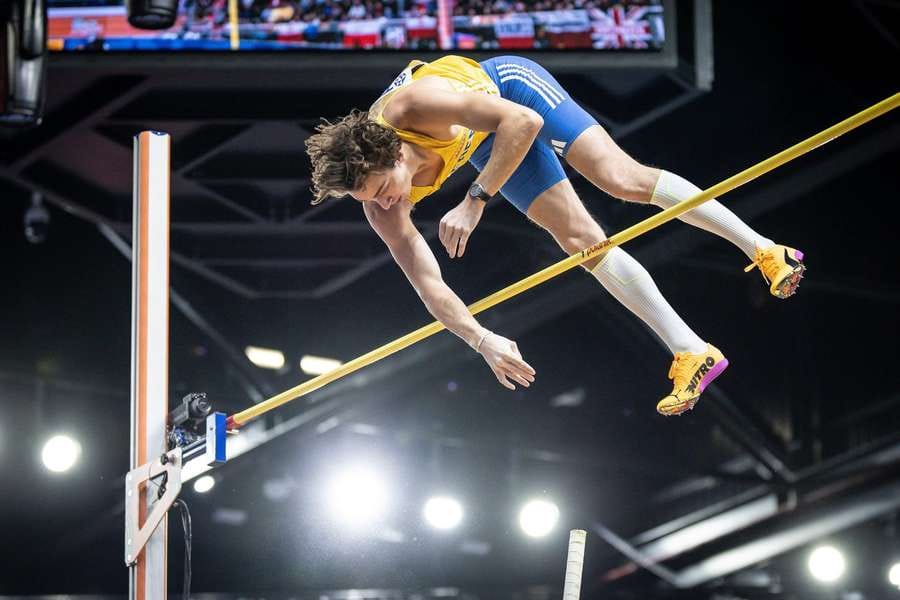
Armand Duplantis, meanwhile, did what Duplantis does. The Swedish pole vault phenomenon claimed his ninth global title and a record-equalling fourth world indoor gold, clearing 6.25m on his first attempt to set a championship record. He elected not to go for another world record attempt, which given that his current world record is 6.27m, was a rare act of restraint from an athlete who has made record-breaking look almost routine.
Final Word
For Josh Kerr, this gold medal is about more than a result at a championships. It is a statement — that the injury in Tokyo did not define him, that the months on crutches were a chapter not a conclusion, and that the people around him, particularly his mum, did not let him quit on himself when quitting would have been understandable.
He’s back. And he made it look harder than it needed to be, which, in a perverse way, made it all the more human.
Source: BBC Sport