



Written by RT Johno
There is a moment in a high jump competition when the crowd stops breathing. The bar is set somewhere the human body was not designed to reach, and a single athlete stands at the end of a curved runway, rocking on her heels, calculating angles and improbabilities, summoning everything she has. On the morning of March 20, 2026, inside the Toruń Arena in northern Poland, that moment happened four times in a row — and each time, the bar stayed exactly where it was.
Four women. One height. One hundred and ninety-nine centimetres. All of them clearing it on their first attempt.
It was, by any measure, one of the most extraordinary high jump competitions in the history of the World Athletics Indoor Championships. When it was over, three of them would share silver. One of them would stand alone on the top step — and for reasons that had nothing to do with athletics alone, her tears felt like something more.
The Australian Who Had Nothing Left — and Found Everything
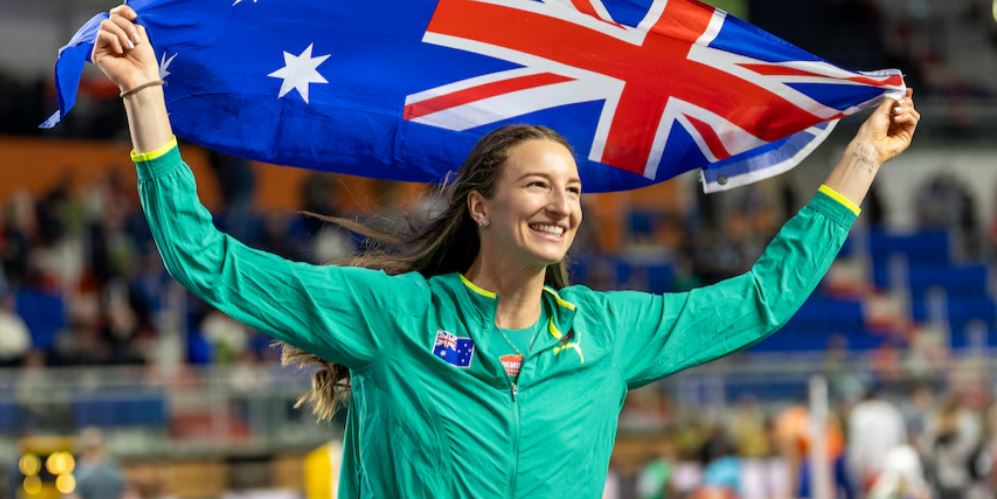
Nicola Olyslagers arrived in Toruń as the two-time defending world indoor champion. She had won this title in Glasgow in 2024, then again in 2025. No woman had ever won three consecutive world indoor high jump titles. She was attempting history.
She also woke up on competition morning feeling flat.
“Sometimes, you just wake up and do not feel ready to compete,” she said afterward. “Today was one of those days but I just prayed and was able to make myself feel the right way.”
What followed was not the performance of a champion running on peak form. It was something rarer: the performance of a champion who has no peak form to offer and digs anyway. Olyslagers cleared four consecutive bars from 1.89m without a miss. Clean. Precise. Technically immaculate under conditions that would have crumbled a lesser competitor. When 1.99m was set on the standards, she ran, she flew, she cleared it on her first attempt — equalling her indoor personal best.
“I wasn’t feeling in my absolute championship best shape, so I just thought to myself, ‘What have I got to give today?’” she told ABC Australia. “I just realised it was just the simple joy of jumping.”
That phrase deserves a moment. The simple joy of jumping. Here is a woman who has won every major title the high jump offers — world indoor champion twice over, world outdoor champion, one of the most decorated Australian track and field athletes of her generation — standing in a world championship arena on a day when her body refuses to cooperate, and finding her way back to the beginning. Back to why she runs up to a bar and throws herself over it in the first place.
“Clearing 1.99m was probably a bigger surprise to me than to anyone else,” she said, “and it feels great to share this medal with two other girls.”
“I’m really stoked to equal my indoor PB and this medal means a lot, because it showed me that there is so much more to give even when everything isn’t perfect.”
That is the lesson Toruń taught Nicola Olyslagers. And it may prove more valuable than gold.
Three Silver Medals and a Piece of History
The mathematics of the final were almost absurd. Olyslagers was not alone at 1.99m. When the dust settled, she was joined there by Angelina Topic of Serbia and Yuliia Levchenko of Ukraine — three women sharing the second step of the podium, all of them clearing the same bar on their first attempt, all of them falling short at 2.01m.
A three-way tie for silver at a World Athletics Indoor Championship. It had happened only twice before in the entire history of the event — in the women’s high jump in 2012, and in the men’s high jump for bronze in 2004. The Toruń Arena witnessed something genuinely rare.
“The competition was amazing,” Olyslagers said. “I cannot remember the last time we had something like that, with four girls clearing 1.99m on their first attempt.”
She was not wrong to be amazed. In a world championship final — where pressure calcifies technique, where nerves tighten approach runs, where the weight of expectation turns first attempts into white-knuckle ordeals — all four of the top finishers cleared both 1.96m and 1.99m first time. It was a collective display of excellence that elevated the entire event into something worth remembering for decades.
Angelina Topic: Twenty Years Old and Already Here
Among those sharing silver with Olyslagers was Angelina Topic, a 20-year-old Serbian who has announced herself to the world with a velocity that is borderline alarming. On February 24, just weeks before Toruń, she set a Serbian national record by clearing 2.00m — making her the only athlete in the world besides Yaroslava Mahuchikh to have reached that height this season.
She came to Poland as a genuine medal contender, and she delivered.
“I don’t remember a competition at this level being so high, a competition where you had to clear 1.99m at the first attempt in order to win a medal,” Topic said. “It was a crazy competition.”
There is something significant about a 20-year-old absorbing that kind of pressure and clearing those heights without flinching. Topic also noted that this was her second time sharing a championship medal — she previously shared a bronze at the Tokyo Olympics. The composure required to compete at that level at that age is not something you can manufacture. She has it.
The high jump world should expect to hear from her for a very long time.
Levchenko’s Return
The third member of the silver trio was Yuliia Levchenko, a 28-year-old Ukrainian who won world silver at the 2017 World Athletics Championships in London. A long stretch of time passed between that podium and this one. Toruń represented something more than a medal — it was confirmation that she belongs among the world’s very best again.
There was a particular moment after the competition ended that caught the eye. Yaroslava Mahuchikh — gold in hand, still processing her own achievement — wrapped Levchenko in a warm embrace. Two Ukrainian athletes, sharing a podium together at a championship held in a Polish city that has become home to tens of thousands of their displaced countrypeople. The symbolism was not lost on anyone in the arena.
Mahuchikh: Gold, Joy, and Going Home
Let us be clear about what Yaroslava Mahuchikh is. She is 24 years old. She is the Olympic champion, having won gold in Paris in 2024. She is the world record holder at 2.10m, a mark she set in 2024 when she finally eclipsed Stefka Kostadinova’s legendary 2.09m that had stood since 1987. She is the world indoor champion, having won this title in Belgrade in 2022. She won the European indoor title as a teenager — a 19-year-old in this same Toruń Arena in 2021. She completed the full set of world indoor medals in 2025 when, hampered by an ankle injury, she finished third at the world indoors and world outdoors. She is, by any reasonable assessment, the greatest high jumper in the world and quite possibly of her generation.
And yet, walking into the arena on March 20, she carried a particular hunger.
“Before Torun, I had already collected the full set of world indoor medals but, coming here, I realised how I’m hungry for the gold one,” she said.
She entered the competition late, her first bar set at 1.93m while others had started lower. She cleared everything first time, bar after bar, with the controlled inevitability of someone who has done this so many times in so many arenas that the mechanics feel like breathing. When 2.01m was set, the three women who would share silver all failed. Mahuchikh cleared it on her first attempt. That was the competition, decided in one movement, decisive and clean.
Afterward, she pushed further — attempting a championship record of 2.06m on three occasions. The existing record is 2.05m, set by Kostadinova in 1987, the same Kostadinova whose world record Mahuchikh had toppled two years earlier. She did not get it. She was not particularly bothered. There was too much else to feel.
Because this was not just any arena. And this was not just any city.
“I started my successful senior career in this arena in 2021 but today I had a different feeling. Torun is the city where many Ukrainians moved after the war was started in our country but I was really surprised how many fans came here to support me. It was amazing. They gave me a lot of energy and motivation to raise the bar higher even though I’d already won the gold.”
Russia’s full-scale invasion of Ukraine began in February 2022. For four years, Mahuchikh could not train at home in Dnipro. She competed, she trained, she won medals all over the world, but not from home. This winter, for the first time since the war started, she returned. She spent the indoor preparation season in Dnipro.
Athletes who have watched her closely this season noted something different. A looseness, a warmth, a joy in competition that had been compressed under the weight of displacement and grief. The girl from Dnipro, training in Dnipro again for the first time in four years, arriving in Toruń — a city filled with her countrypeople — and winning gold in the arena where her senior career began.
Some narratives write themselves.
Patterson and the Australian High Jump Picture
Eleanor Patterson, Australia’s 2022 world outdoor champion and one of the best high jumpers on earth in her own right, had a difficult morning. She cleared 1.93m to finish seventh. On a day when the top four were operating in a different atmosphere entirely, Patterson could not find the heights that have defined her career at major championships. It was a tough result for a genuine world-class competitor.
The contrast between Patterson’s day and Olyslagers’ — one athlete failing to reach her best, the other failing to reach her best but somehow arriving there anyway — illustrates something about the randomness of championship athletics. Both women are elite. On March 20, one of them found something extra. The other did not. That is the sport.
Australia’s Broader Day One
The women’s high jump final was the headline Australian story of the morning session, but there was genuine substance elsewhere in the programme. Australia arrived at the World Athletics Indoor Championships with a competitive squad, and Day One offered early confirmation that the medals conversation would not be limited to the field events.
In the women’s 1500m heats, Jessica Hull ran 4:12.45 to finish second in her heat and advance comfortably to the final. Hull has been building toward a major championship performance, and the ease of her qualification suggested she is conserving something for when it matters.
Adam Spencer qualified through the men’s 1500m heats, running 3:40.79 for second in his heat. Peter Bol, Australia’s most prominent 800m runner, won his heat outright in 1:45.87 — a controlled, confident performance from an athlete who knows exactly how to navigate the pressure of championship running. Hayley Kitching also progressed through the women’s 800m, finishing second in her heat in 2:00.09.
All four advance to their respective finals, giving Australia a meaningful presence across the middle-distance programme as the championships develop.
What 1.99m Felt Like
Step back from the scoreboard for a moment and try to feel what happened inside the Toruń Arena on Friday morning.
Four women — an Australian champion, a Ukrainian prodigy, a Serbian teenager, and a Ukrainian veteran — all standing at the end of a runway with the same bar in front of them. One metre, ninety-nine centimetres. At a world championship. All four clearing it without a miss. The crowd in that moment, watching the bar stay still after each attempt, knowing that every single athlete left in the competition had just cleared an almost unimaginable height at first attempt — that is not something you forget if you were there.
Olyslagers herself captured it perfectly.
“But being in a situation like this gives me a sense of excitement, it does not scare me. It reminds me to have motivation to jump well.”
That is a champion’s relationship with pressure. Not the absence of nerves, but the conversion of nerves into fuel. The best athletes in the world do not suppress what they feel in moments like that — they use it. And on a day when she felt nothing close to her best, Nicola Olyslagers used everything she had.
Final Results: Women’s High Jump — World Athletics Indoor Championships 2026
1. Yaroslava Mahuchikh (UKR) — 2.01m (Gold)
2. Nicola Olyslagers (AUS) — 1.99m (Silver, shared)
2. Angelina Topic (SRB) — 1.99m (Silver, shared)
2. Yuliia Levchenko (UKR) — 1.99m (Silver, shared)
5. Maria Zodzik (POL) — 1.93m
6. Louise Ekman (SWE) — 1.93m
7. Eleanor Patterson (AUS) — 1.93m
The World Athletics Indoor Championships continue in Toruń, Poland, through March 22, 2026.