

 and Berlin (2:02:27), and now London again. Never mind the width, feel the quality.)

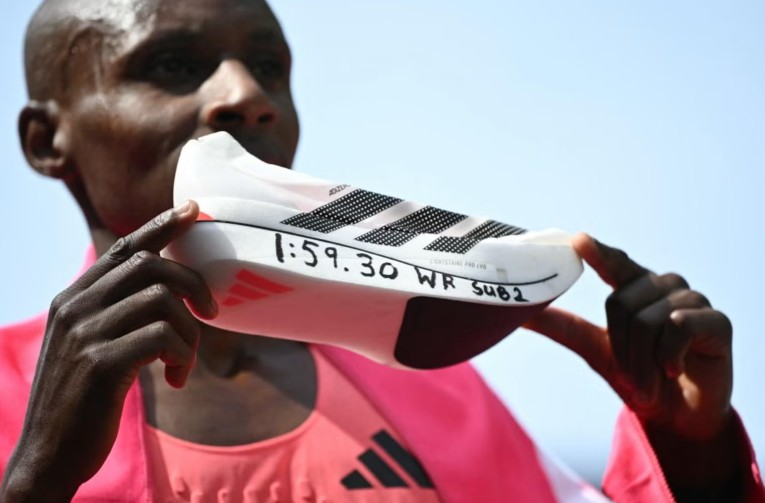
Forget the shoes: adidas will provide regular reminders anyway.
Forget the super-drink: one member of our chat group wondered whether a much cheaper mix of flat coke, soda water, hydralyte, choc milk, fruit, etc might tick the same boxes. In response I recounted my disastrous experience re-hydrating with strawberry flavoured milk back in the early days of the Melbourne Marathon when the naming rights sponsor was Big M Milk).
Don’t even mention the tailwind. Though London qualifies as record-legal (the start and finish, while separate, are close enough – i.e. less than half the race distance – to be classified as a ‘loop’), it is predominantly east to west and a light wind blew from the east on race day. My UK-based observer noted it “provided a little assistance in the last few kilometres.”
Likewise, ignore the nett altitude loss. Again it does not exceed the 1m per kilometre which would cause London to be officially downhill, but almost all of the downhill comes early in the race, helping racers to establish a fast pace with minimal energy expenditure (provided such pace is not too fast).
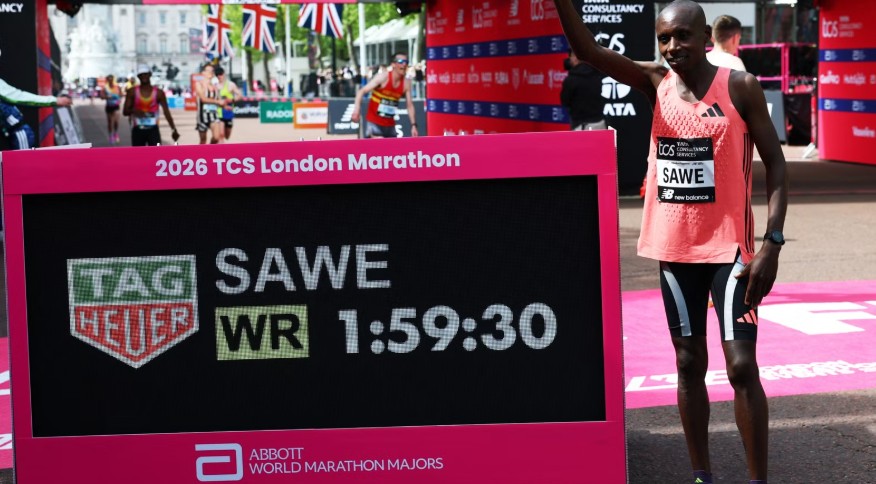
While we’re at it, forget the 1:59:30 world record (and the 1:59:41 second place). And the 2:15:41 women-only ‘world record’ (and 2:15:53 and 2:15:55 second and third). Because, in the end, what the London Marathon 2026 was about was not cutting edge shoe or nutrition technology. Nor world records, nor unicorn conditions.
Rather, what London 2026 was about was racing, world-class racing. Two men and three women fighting for the win over the closing stages. No quarter given, no recourse to ‘tactics’ – as running slower is sometimes euphemistically characterised – in search of the win: just all-out racing to the finish.
“Damn the torpedoes; full steam ahead.” That sort of thing.
I’m not privy to when and from where Charles and Camilla departed the UK for their trip to the US but I trust they had time to take in the finish of the race on their front doorstep before they headed off to the White House.
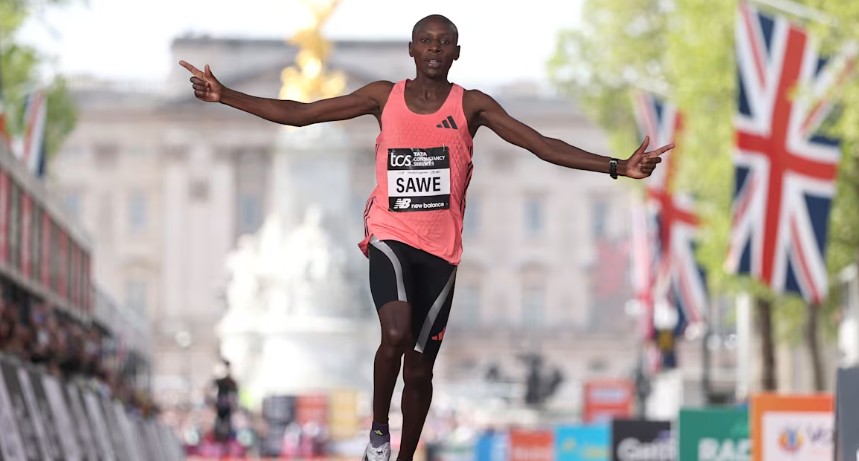
As most readers would know Sabastian Sawe won by 11 seconds from Yomif Kejelcha as they became the first two men to run under two hours officially for the marathon. Sawe’s 1:59:30 took 65 seconds off the world record previously held by the late Kelvin Kiptum. Kejelcha and three-time world cross-country champion Jacob Kiplimo (third in 2:00:28) were all under Kiptum’s 2:20:35.
And Sawe also ran the fastest marathon of all-time. His 1:59:30 was quicker than Eliud Kipchoge’s unofficial sub-2, his 1:59:41 in Vienna in 2019. That performance was aided by a pace car and rotating teams of pacemakers, so could not be ratified as an official world record.
Thus, Sawe stymied any ambiguity over the fastest marathon yet run, though he has some way to go yet to equal Kipchoge’s status as a dual Olympic champion and multiple world record setter and his undoubted claims to all-time great distance runner.
Now aged 31, Sawe may never match Kipchoge for longevity. But he has not put a foot wrong since he made his marathon debut in Valencia in 2024. He won then in 2:02:05, followed up with wins in London last year (2:02:16) and Berlin (2:02:27), and now London again. Never mind the width, feel the quality.
Poor Kejelcha (we use the descriptor advisedly) continues to compile a phenomenal performance record without ever winning anything much. He is now the second man under two hours, the second-fastest marathoner ever, to go with his two world championships silver medals at 10,000 metres – Doha 2019 and Budapest 2023 behind Joshua Cheptegei and Jimmy Gressier, respectively. He has also held the world record for the indoor mile and ranks fourth-fastest all-time at 5000 and seventh at 10,000.
The women’s race was a three-way battle between Tigst Assefa, Hellen Obiri and Joyclinine Jepkosgei of the like we haven’t seen since … checks notes … Sifan Hassan, Assefa and Obiri fought out the finish of the Paris 2024 Olympic race. Hassan prevailed then as 15 seconds separated the three medallists.
In London, it was even closer, just 14 seconds separating Assefa (2:15:41) from Obiri (2:15:53) and Jepkosgei (2:15:55) in the fastest ever women-only race.
It’s always great when fast races accompany close races in marathons. We only have to go back to the world championships in Tokyo last year for precedents. Five seconds separated the men’s medallists then, Alphonce Simbu and Amanal Petros both running 2:09:48 in first and second and Iliass Aouani third in 2:09:53. Peres Jepchirchir beat Assefa then by just two seconds, 2:24:43 to 2:24:45.
Then, as mentioned, there was the eyeballs – and elbows! – out finish between Hassan and Assefa in the Paris Olympic race with Obiri right on their heels in third.
Our very own Deek was involved in a close finish or two, chasing down the runaway Juma Ikangaa in the Brisbane Commonwealth Games marathon in 1982 and then edging out Carlos Lopes to win Rotterdam the following year, 2:08:37 to 2:08:39. Deek surged a 14:47 split from 35 to 40km and an estimated (guestimated?) final 400 in just over 60 seconds as he held off Lopes every step of the last 5km.
Happy days they were!